skip to main |
skip to sidebar
Since we are entering in the season where the most awaited festivity of the year lies, I'll tell you about what the Julbock is, since that this December of 2013 I will not speak of any celebration during this season because I've written about this subject numerous times in other posts.
The Julbock or Yule Buck is an holiday custom, a goat made of straw, a little object filled with history that comes from the ancient times when Northern Europe hadn't been touched by christianization and people were still heathens, celebrating their own holidays.
I actually got my first Julbocks this year, I found them to be really interesting we back home we wanted to decorate the house with those during this season. We bought two little ones and I joked about those being Thor's goats... well I wasn't far from the truth, having something in the house and not knowing its real meaning isn't right for me so I have made some research.
Of course this little symbol has an obvious connection with Thor's goats, Tanngrisnir and Tanngnjóstr (Toothgnasher and Toothgrinder) and the story of Father Winter comes again, there is much speculation to who is the real Santa Claus. Well, one thing we can be certain, this is something that goes back in history in a time before the Christian figure of Saint Nickolas. The figure of Father Winter tend to be linked to Odin or Thor.
There wused to be a Swedish folk custom that was directly related to Snorri Sturluson's account of Thor killing his goats for a feast and then raising them from the dead the next day, a story we don't get tired of hearing especially when it involves the adventure of Tjalf and Roskva. Unfortunately this custom seems to have gone since the mid twenty century (1900's). The performance is described as an actor, hidden by a coverlet made of skins and wearing a pair of horns, is led into the room by two men, who make believe that they are slaughtering him, while they sing verses referring to the mantles of various colours, whire, red, yellow and blue, which they laid on him, one after the other. At the end of the song, the Jolbock or the Yule Goat, after feigning death, jumps up and skips about to the amusement of all of those who were watching.
We usually see goats in the Norse folklore, most of the times the goat is the companion of the Tomte, a small mythological creature associated with the winter solstice, no taller than three feet, and has a long white beard and colorful clothes, very much like a Gnome. The Tomte or the Tomten, are usually known as the gift bearers, deeply connected with the goat and here we can see the connection to Father Winter, giving gifts, as Odin is often called, The Gift-bearer, The giver of gifts etc.
There is also a Norwegian custom called the Julebukking, where people wear masks and costumes called Julebukkers and go from door to door and neighbors who receive them try to identify who is under the disguise. The Julebukkers will of course attempt to disguise their voices and body language. Offering Julebukkers treats and something to drink is a tradition. Once the Julebukkers have been identified and whatever was given to them is consumed, they move on to the next house. Another tradition requires that at least one person from the visited household join the band of Julebukkers and continue to the next household.
The Julbock is burned during the bonfires that are set during this season as an offering to the gods. Some people write messages to the gods in a piece of paper and place them in the red ribbon in the goat's neck.
It is interesting to see that this pagan symbol still survives to this day and I'm really happy that I got my first Julbock this year, from my mother side and from my father's father side my ancestors were Norse and Germanic, but many traditions were lost.. but the moment I saw that goat made of straw, something inside of me awoke, perhaps a feeling shared by my ancestors that still runs through my veins.
Note: If you have any questions for me or if you want to see my artistic works, check out my Facebook page and make a Like if you can by following this link --> http://www.facebook.com/ArithHarger
 Thor is the Germanic/Norse god of thunders, storms and rain! Well he doesn't need much introductions, he is the most famous god of all the Norse pantheon, he is the god that people gave much importance to, for his bravery, his many adventures and for being one of the gods most close to the human kind and also a great friend of the peoples of Midgard. Recently the Marvel movies about Thor widened the interests of the populations in knowing who this god is, suffice to say that the real on from the Norse myths is very different from the Marvel one and it is important to state this this fact, for the real Thor is of great importance to all and there is more in him than all the stories we are all used to listen. I feel the need to make a post about him, because to the Neo-pagans he has become a cliche figure, people don't know his true nature, nor they give him the proper value, for many.. he is just the symbol Mjölnir neckless around the neck.. we mustn't forget his true powers and how important he is.
Thor was one of the most popular gods among the Germanic/Norse tribes, famous as he was, we nowadays see the great importance he had once, for his hammer is the symbol most used as a genetic symbol of modern Heathens, Asatru and other followers of the Norse/Germanic paganism. In England he was known as Thunor and to the Germans he was Donar, also the Saami people whorshiped a figure carved in a trunk of Oak with a hammer in hand, called the Old thunderer father, this might have been the first source of Thor when the Scandinavians got in contact with the Saami, or maybe the first source could have been the celtic god Sucellos, very much famour in Gaul ( Modern France ), Britain and Lusitânia ( Modern Portugal ), a god whose name means "the good striker", often said to be a deity of agriculture and forests, yet no one knows his true powers and purposes, but what is known it that he was a long haired bearded figure carrying a hammer in his left hand, this was actually his main attribute, this hammer.
Important as Thor was, we got the weekend name "Thursday" from his own name, meaning "Thor's Day". He is also a Deity of fertility, bringing us closer to the Celtic source of the god Sucellos from agriculture, but also a deity of strength. Just as the Greek thunder-god Zeus, Thor is also associated with the oak tree, once again this brings us to the Celtic god Sucellos, for being on of the important gods of Lusitânia ( Modern Portugal ) a land filled with Oaks from which people made all kinds of objects from it's bark and it was also a very sacred tree for the Lusitanian people, for when a child was born, the placenta was thought to be the double of the baby, a part from him and his spirit, the protective natural cloak, and so the placenta was placed underneath an Oak Tree so that the person would always have a part of him/her connected to nature and the magical/healing/protective powers of the Spirits of the Oak tree. The Oak tree is also associated with Thor because its bark is a poor conductor of lightning, unlike other trees, oaks explode when they are struck by lightning, creating a field of flamming wooden bits that usually were collected and used to start fires, this might have been the first controlled fire that humankind has experienced in primordial times, so this gives us the hint that the gods of thunder are older than they seem, way back before history was recorded. This may be why Thor is associated with giving to humans their first warmth and safety.
Thor is the patron of common man, in other meanings, the ancient times farmers. He is the champion of Asgard, with the power of his hammer and his utmost bravery, he is sent to deal with all kind of troubles that threaten Asgard. He is a very tall god with immense strength, taking after his mother, the giantess Jord goddess of the Earth, he is also red haired and red bearded, not like the Marvel Thor people recently are so used to. We see in him the true spirit of a common Norse Warrior, impulsive and honest, quick to party and also quick to anger, he likes to drink a lot, bue everyone can count on him when it is needed, he is completely reliable. His primary concerns are with honesty and honor, keeping promises and making sure that others keep theirs, it is important for him that when someone does something, anything, whatever one might do, must be with whole their hearts. meaning that we must be ready to defend what is most important for us, keeping our promises and commitments, being loyal to those we love and to our friends.
As i have mention it, he is the son of Jord, the first lover of Odin, his wife is Sif and with her he has a daughter called Thrud. He also has two sons with the giantess Jarnsaxa, which are Magni and Modi. Thor also has a younger brother by a different father, Meile. He is also the stepfather of Ullr, born from Sif's first marriage. The image we are used to think of when talking about Thor, is him riding a chariot pulled by two goats, Tanngrisnir and Tanngnjostr, with his hammer Mjölnir.
It is seldom mentioned, but one of Odin's lover, the giantess Grid, gave to Thor a magical belt of strength called Mengingjord, a pair of magical iron gloves named Jarngreipr, and also a magical staff called Gridavolr.
The famous Asgard Hall named Bilskimir is Thor's Hall, the largest building in all the Nine realms with six hundred and forty four rooms, there are many servents in his Halls and the chief servants are Thjalfi/Thjalfr and Roskva, tow of the three children of Aurvandil, Thor's hunting companion and Sif's former husband with this giantess wife Groa. In other stories, Thjalfr and Roskva are the children of a pair of farmers or peasants who give Thor shelter for a night and accidentally hurt one of his goats, and so Thor took the children as servents in payment.
There is an interesting fact that most people don't know, but Thor can shift from ordinary human size to being as huge as any giant, this is how he manages the fight giants so often. However, one of the side effects of this talent is that even when is in the ordinary size of a human ( about six feet tall ) he weighs as much as he would weight if he was in the giant size ( about twenty feet tall ). It is because of this fact that he is the only god who cannot cross the rainbow bridge Bifrost, and must get in and out of Asgard through the river Thund Thvitr that surronds it.
Thor is the most famous of all gods because there are more stories and myths about him than any other god in the Norse mythology, maybe perhaps Loki, but even so, the two of them were traveling companions for quite some time in many adventures.
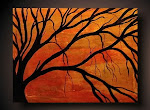
Note: The artwork to illustrate this post is a painting of an Oak three made by me with the title Þórs Eik Tré which means "Thor's Oak Three" in old Nose. If you have any questions for me or if you want to see my artistic works, check out my Facebook page and make a Like if you can by following this link --> http://www.facebook.com/ArithHarger
Thor is the Germanic/Norse god of thunders, storms and rain! Well he doesn't need much introductions, he is the most famous god of all the Norse pantheon, he is the god that people gave much importance to, for his bravery, his many adventures and for being one of the gods most close to the human kind and also a great friend of the peoples of Midgard. Recently the Marvel movies about Thor widened the interests of the populations in knowing who this god is, suffice to say that the real on from the Norse myths is very different from the Marvel one and it is important to state this this fact, for the real Thor is of great importance to all and there is more in him than all the stories we are all used to listen. I feel the need to make a post about him, because to the Neo-pagans he has become a cliche figure, people don't know his true nature, nor they give him the proper value, for many.. he is just the symbol Mjölnir neckless around the neck.. we mustn't forget his true powers and how important he is.
Thor was one of the most popular gods among the Germanic/Norse tribes, famous as he was, we nowadays see the great importance he had once, for his hammer is the symbol most used as a genetic symbol of modern Heathens, Asatru and other followers of the Norse/Germanic paganism. In England he was known as Thunor and to the Germans he was Donar, also the Saami people whorshiped a figure carved in a trunk of Oak with a hammer in hand, called the Old thunderer father, this might have been the first source of Thor when the Scandinavians got in contact with the Saami, or maybe the first source could have been the celtic god Sucellos, very much famour in Gaul ( Modern France ), Britain and Lusitânia ( Modern Portugal ), a god whose name means "the good striker", often said to be a deity of agriculture and forests, yet no one knows his true powers and purposes, but what is known it that he was a long haired bearded figure carrying a hammer in his left hand, this was actually his main attribute, this hammer.
Important as Thor was, we got the weekend name "Thursday" from his own name, meaning "Thor's Day". He is also a Deity of fertility, bringing us closer to the Celtic source of the god Sucellos from agriculture, but also a deity of strength. Just as the Greek thunder-god Zeus, Thor is also associated with the oak tree, once again this brings us to the Celtic god Sucellos, for being on of the important gods of Lusitânia ( Modern Portugal ) a land filled with Oaks from which people made all kinds of objects from it's bark and it was also a very sacred tree for the Lusitanian people, for when a child was born, the placenta was thought to be the double of the baby, a part from him and his spirit, the protective natural cloak, and so the placenta was placed underneath an Oak Tree so that the person would always have a part of him/her connected to nature and the magical/healing/protective powers of the Spirits of the Oak tree. The Oak tree is also associated with Thor because its bark is a poor conductor of lightning, unlike other trees, oaks explode when they are struck by lightning, creating a field of flamming wooden bits that usually were collected and used to start fires, this might have been the first controlled fire that humankind has experienced in primordial times, so this gives us the hint that the gods of thunder are older than they seem, way back before history was recorded. This may be why Thor is associated with giving to humans their first warmth and safety.
Thor is the patron of common man, in other meanings, the ancient times farmers. He is the champion of Asgard, with the power of his hammer and his utmost bravery, he is sent to deal with all kind of troubles that threaten Asgard. He is a very tall god with immense strength, taking after his mother, the giantess Jord goddess of the Earth, he is also red haired and red bearded, not like the Marvel Thor people recently are so used to. We see in him the true spirit of a common Norse Warrior, impulsive and honest, quick to party and also quick to anger, he likes to drink a lot, bue everyone can count on him when it is needed, he is completely reliable. His primary concerns are with honesty and honor, keeping promises and making sure that others keep theirs, it is important for him that when someone does something, anything, whatever one might do, must be with whole their hearts. meaning that we must be ready to defend what is most important for us, keeping our promises and commitments, being loyal to those we love and to our friends.
As i have mention it, he is the son of Jord, the first lover of Odin, his wife is Sif and with her he has a daughter called Thrud. He also has two sons with the giantess Jarnsaxa, which are Magni and Modi. Thor also has a younger brother by a different father, Meile. He is also the stepfather of Ullr, born from Sif's first marriage. The image we are used to think of when talking about Thor, is him riding a chariot pulled by two goats, Tanngrisnir and Tanngnjostr, with his hammer Mjölnir.
It is seldom mentioned, but one of Odin's lover, the giantess Grid, gave to Thor a magical belt of strength called Mengingjord, a pair of magical iron gloves named Jarngreipr, and also a magical staff called Gridavolr.
The famous Asgard Hall named Bilskimir is Thor's Hall, the largest building in all the Nine realms with six hundred and forty four rooms, there are many servents in his Halls and the chief servants are Thjalfi/Thjalfr and Roskva, tow of the three children of Aurvandil, Thor's hunting companion and Sif's former husband with this giantess wife Groa. In other stories, Thjalfr and Roskva are the children of a pair of farmers or peasants who give Thor shelter for a night and accidentally hurt one of his goats, and so Thor took the children as servents in payment.
There is an interesting fact that most people don't know, but Thor can shift from ordinary human size to being as huge as any giant, this is how he manages the fight giants so often. However, one of the side effects of this talent is that even when is in the ordinary size of a human ( about six feet tall ) he weighs as much as he would weight if he was in the giant size ( about twenty feet tall ). It is because of this fact that he is the only god who cannot cross the rainbow bridge Bifrost, and must get in and out of Asgard through the river Thund Thvitr that surronds it.
Thor is the most famous of all gods because there are more stories and myths about him than any other god in the Norse mythology, maybe perhaps Loki, but even so, the two of them were traveling companions for quite some time in many adventures.
Note: The artwork to illustrate this post is a painting of an Oak three made by me with the title Þórs Eik Tré which means "Thor's Oak Three" in old Nose. If you have any questions for me or if you want to see my artistic works, check out my Facebook page and make a Like if you can by following this link --> http://www.facebook.com/ArithHarger


 Posts
Posts