Wight of the Nine Worlds

welcome

I welcome thee free spirit, which thou shalt come with an open heart, open mind and an open soul, for what you are about to read can only be understood by the wise who are eager to learn and to embrace the roots deep and forgotten in the hearts of the free people of Europe, by accepting who you are and where your roots lie, is half way into the great road of life. We will journey unto where our spirit takes us with the knowledge we gained. Learn and teach.
Showing posts with label germanic. Show all posts

The Bear - Symbology During the Middle-Ages


You can watch the video about this subject in here: [The Bear - Symbology During the Middle-Ages]


When people ask you “what animal is the king of all animals?” the first creature to come to mind is the lion. But in truth, before the church imposed the lion as the king of all the animals, the bear was the real king, at least in the European continent. The bear was the symbol of power, strength and majesty.

It is possible that our ancestors during prehistoric times already worshiped bears. We can find bear skulls aligned in niches in caves, and they weren’t placed in there at random. There might have been an early bear cult, and unlike the image we grow up with, of people living in caves, our ancestors actually built houses made of huge animal bones and tusks, tree-trunks and animal skins, so those caves with beautiful paintings, were in fact out ancestors’ first temples. But let's not go back so much in history.

Anyway, we can find traces of the utmost respect, even fear and also admiration our ancestors had for these creatures, in folktales, changed by time and the different political and social realities throughout history, and of course, changed by new faiths. We can also see it in sacred places, christianised, but were once the places of pagan deities and with the new faith became the dwelling places of saints and Christian mythological accounts. For instance, the Celts worshiped a goddess which was represented with a bear on her side or in front of her. The bear goddess called Artio, and the name has a lot of similarities with Arthur, who in turn is also a name connected with bears. This was a primitive deity, linked to the fertilizing force of the earth, in a time when gods had not yet been anthropomorphized and were still represented as animals.

There were certain early Cristian accounts that show the importance the bear had to the pagans, and as such, the devil often took the form of a bear to come and terrorized the monks. The king of animals was turned against those who admired it, by demonizing the poor animal. In the Jewish and Christian traditions, the bear often has a negative symbology, and you can see that in the Old Testament.

When the missionaries began their process of evangelization through Europe, they encountered a variety of pagan deities, many of which were either associated with bears, or were bears themselves. To the Germanic and Celtic populations of Europe, the bear was the animal associated with royalty, so it isn't a coincidence that the most famous legendary king, Arthur, was also associated with the bear. It’s interesting to see that the bear, well, the she-bear, was connected to the warrior goddess Brigid, of whom the Celtic kings were sons of, making them little bear cubs. So there was the necessity to christianise this goddess, and so Saint Brigid was born, and later, this pagan goddess, now christianised, was associated with a real abbess of Kildare named Brigid, who died more or less in the year of 525 of our era.

To the Germanic and Scandinavian peoples, the bear was connected to the warrior spirit, personified by the god Thor. It appears that in certain Germanic groups, one of the imposed trials to the young warriors, was the solitary bear hunt. Although it hasn't been proven yet if these initiation rites were real or just mythical. Anyway, what is real is that the strength and the ferocity of the bear was an inspiration to the Germanic and Scandinavian warriors.

Many ancient cities throughout Europe still have the representation of the bear in their coat-of-arms. The survival evidences of the bear being the king of animals before the church replaced the symbolic functions of the bear for the lion. The lion was an exotic animal, and by the time it replaced the bear, sometime in the year 1000, the lion didn't belong to the European Fauna so this almost mythical creature during medieval times was easily adopted. But to this day some cities such as Bern in Switzerland and Berlin in Germany, to name a few, still have the bear in their coat-of-arms.

It's not a coincidence that during the reign of Charlemagne a lot of bears were hunted almost till extinction, because of the cult the Germanic peoples had and the pagan gods associated with the animal, and of course taking down loads of sacred trees. We all know about the forest devastation held by Charlemagne and his nobles, but we don't often hear about the bear-hunt.

To the church, during medieval times, the bear was the personification of evil, ferocity and chaos, because the creature lived in the dense, almost unreachable, forests. The forests were the dwelling places of the pagans (in truth the forests were the places the pagans considered to be sacred, once, but now it was their refuge from the horrible acts of forced cristianization). But the bear started to enter in the christian mythology in another way. It became the symbol of the divine dominating chaos, because the only ones who could contact with these terrible creatures and turn them into docile animals, were the hermits; those who would seek the most inhospitable places to live in solitude, for spiritual reasons. Only through their faith, and the connection with the divine and the power of god, could they do such a thing, turning a ferocious beast into a docile companion. Thus the bear became the symbol of the victory of the divine over chaos, and we can actually see this representation in the story of Saint Columbanus and his many encounters with bears, and befriending them.

The bear was also associated with the Devil, and a symbol of the many vices and sins condemned by the church. There were many accounts of bears being the evil creatures of chaos, to the point that they became the creatures that would kidnap young beautiful maidens and would rape them. And we can still see this in many folktales; the bear being the "bad guy" in the story. This actually might be the beginning of the creation of the story of "The Beauty and the Beast", highly infantilized and softened by Disney, and thank the gods for that because no child would want to hear about the real account.


So, in conclusion, the fight of the church against the bear, was a symbolic, and in some cases a very real way to free territories from their pagan past and convert them to Christianity and order over chaos. Unfortunately, the bear had a very negative connotation during the middle-ages, but at the same time, the symbolism the bear had during pagan times, somehow prevailed till nowadays, and I'm sure all of us remember the childhood stories of the she-bear being a kind and caring mother, and it isn't a coincidence that many children to this day still sleep with their teddy-bear.

The Gods Behind the Days of the Week


It is of common knowledge that the days of the week are so named after gods and goddesses. But how and why did that happen? Why were such names chosen and what each of them tells us about the deities?

Well... first of all, let's start at the beginning. The concept of week itself probably developed in ancient Babylon in the region of mesopotamia (nowadays Iraq and parts of Syria), where a month was divided into more or less four seven-day periods to match the four phases of the moon. This didn't exactly work out as some weeks were longer than others but by the time of ancient Greece, the seven-day cycle was firmly established and each day of the week had a common name.

To the greeks, the days of the week were so named:

Monday: "hemera selenes" - meaning “day of the moon”
Tuesday: "hemera Areo"- meaning “day of Ares” (the Greek God of War)
Wednesday: "hemera Hermu" -  “day of Hermes” (the Greek God of commerce and travel)
Thursday: "hemera Dios" -  “day of Zeus” (supreme Greek God of the heavens, commonly known as the god of thunders)
Friday: "hemera Aphrodites" - “day of Aphrodite” (Greek Goddess of love and beauty)
Saturday: "hemera Khronu" - “day of Cronus” (supreme Greek God of the universe before Zeus)
Sunday: "hemera heliou" - “day of the sun”

The romans, on the other hand, used the roman equivalent of the greek gods:

Monday: "dies lunae" - “day of the moon”
Tuesday: "dies Martis" - “day of Mars” (the Roman God of War)
Wednesday: "dies Mercurii" - “day of Mercury” (the Roman God of commerce and travel)
Thursday: "dies Jovis" - “day of Jupiter” (supreme Roman God of the heavens)
Friday: "dies Veneris" - “day of Venus” (Roman Goddess of love and beauty)
Saturday: "dies Saturni" - “day of Saturn” (Roman God believed to have ruled in an earlier age)
Sunday: "dies solis" - “day of the sun”

The Welsh for instance, follow the Latin pattern entirely, as do many of the Romance languages throughout Europe. However, the English case is different; it doesn’t follow either Latin or Greek names. Instead, it follows the day names first given by the Anglo-Saxons, and these appear completely different from those of Greek or Latin deities.

Monday: "Mōnandæg" - “day of the moon”
Tuesday: "Tīwesdæg" - “day of Tiw” (the Anglo-Saxon God of war)
Wednesday: "Wōdnesdæg" - “day of Woden” (the chief Anglo-Saxon God equivalent to the Scandinavian Odin)
Thursday: "Þunresdæg" - “day of Thunor/Donar” (the Anglo-Saxon God of thunder, represented as riding a chariot, the equivalent of the Scandinavian Thor). Strictly, the day means “day of Thunder” after Thunor.
Friday: "dies Frīgedæg" - “day of Freya/Freyja or Frigg” (the Anglo-Saxon Goddesses of love and beauty)
Saturday: "Sæternesdæg" - “day of Saturn” (no equivalent Anglo-Saxon God so the Roman God is reused in this case)
Sunday: "Sunnandæg" - “day of the sun” (dæg is pronounced “day” and Sunna/Sol is the goddess of the sun)

It appears that the attributes of each deity are identical (except for Wednesday and Thursday). The Anglo-Saxons clearly did not invent their own terms for each day of the week, but followed Roman practice, turning the Roman deity names into their own. It also tells us how Anglo-Saxons thought about their Gods and which they most closely linked with the Roman equivalent. However, the early Anglo-Saxons saw Thunor (in ancient Norse -Thor) as having qualities shared by Mercury, which indicates that firstly Thor had different attributes to the Norse/Germanic peoples, and wasn't yet the god of Thunder and giant slayer. It is possible that Thor used his chariot for commerce and not just riding to battle. In much of the Western world, the day names are very similar, either taken directly from Latin, or, as we have seen with the English case, taken from the equivalent of the Anglo-Saxon deities.

The Viking Berserkers – Brave warriors or drug-addicted?


Nowadays we often use the word "Berserk" or "to go berserk" to label any person in a irrational state of mind, or a person who isn't able to control his/her actions because the rage is such, that the person enters a frenzy, lunatic state, a destructively person or frenetically violent. The word Berserker or Berserk, comes from the old Norse word "Berserkr", which means "a wild warrior or champion". These warriors wore hides of bears, which might explain the origin of the berserkr as a compound of "Bera" - Bear, and "Serkr" - shirt or coat. These were the fierce viking warriors who were known for battling in an incontrolable trance-like rage, and were alleged to be able to perform seemingly impossible super-human feats of strength, akin only to a wild beast.

In the medieval history and folklore, of both Norse and Germanic, the berserkers were described as members of an unruly warrior band/gang, whose main devine cult was the cult of Odin, the king of the Aesir tribe of gods. The berserkers were also commissioned to royal and noble courts as bodyguards and special elite troops, who would strike fear into all who encountered them.

It wasn't hard to struck fear into the hearts of the enemies, as the berserkers behaved like an animal, roaring, grunting and howling, entering in a state of uncontrollable rage. Most of them would leap towards the enemy, biting shields and gnawing upon the skin of their enemies. 

Dating back as far as the ninth century, the berserker Norse Warriors were said to be able to do things that normal humans could not. According to ancient legend, the berserkers were indestructible, and no weapon could break them from their trance.  They were described as being immune to fire and to the strike of a sword, continuing on their rampage despite injury.

Most anthropological and psychological studies indicate that the Berserkers simply worked themselves up into a self-induced hysteria before fighting, that was part of the cult to Odin, very violent. They would act like animals, abandoning their clothes and dress with animal pelts, an initiation process to leave behind the human condition and become an animal. Other researches indicate that the consumption of drugs or alcohol, or even mental illness, could be the key to understand their behaviour. Some botanists have claimed that berserker behaviour could have been caused by the ingestion of the plant known as bog myrtle, one of the main spices in Scandinavian alcoholic beverages.

Other more esoteric theories surround supernatural beliefs. For instance, some scholars have claimed that the Vikings believed in spirit possession and that berserkers were possessed by the animal spirits of wolves or bears. According to some theorists, berserkers learned to cultivate the ability to allow animal spirits to take over their body during a fight (an example of animal totemism) that also involved drinking the blood of the animal that they wished to be possessed by.
Speaking in a more esoteric term, there are some theories surrounded by supernatural beliefs.For instance, some scholars have claimed that the Vikings believed in spirit possession and that berserkers were possessed by the animal spirits of wolves or bears. According to some theorists, berserkers learned to cultivate the ability to allow animal spirits to take over their body during a fight, an ancient cult of animal totemism linked to shamanism, that also involved drinking the blood of the animal that they wished to be possessed by.

In 1015, Jarl Eiríkr Hákonarson of Norway outlawed berserkers. The Grágás, the medieval Icelandic law code, sentenced berserker warriors to outlawry. By the 12th century, organised berserker war-gangs had been completely disbanded.

Viking Invasions in the Iberian Peninsula


Viking Invasions in the Iberian Peninsula

ATTENTION! Read the description below. This is NOT Fiction. This is my final work after 6 months of research, from historical books and documentation as my source of study.

As you can see in this map that I have made, the red area are the territories where the Vikings have been. Between the IX and XI centuries the Vikings invaded the Iberian Peninsula. They did not only raid territories, but also made settlements, colonies, winter camps and also made a living. More than 200 years of Viking presence in the land, documented in that time by the peoples that inhabited the Iberian Peninsula. Lots of raids, battles, colonisations, invasions, and so on, have been registered, but I'm certain that the Vikings went further inland, because they used the rivers as their routes to spread all over the land. Note that in these 200 years, the kingdoms of the Iberian Peninsula and their boundaries changed a lot. Territories have been conquered and lost, the christian kingdoms of the North against the Muslim kingdom of the South. The christian kingdoms of the North belonged to the Germanic descendants of the Iberian Peninsula who made the first Christian Kingdoms of the land, after the decline of the Roman Empire. The kingdoms were formed around the V century C.E. by the Swabians, Vandals, Goths and Visigoths, all germanic peoples from nowadays Germany, Norway and Lower Sweden respectively. In the beginning of the VIII century C.E. the Iberian Peninsula was invaded by the Muslims, who pushed the germanic territories to the north, thus ending the germanic nations of the Iberian lands. Between the IX and XI centuries, the Vikings invaded these lands, and fought against the descendants of their ancestors and also against the Muslims of the south. Many battles were recorded, on both land and sea. But the Vikings also colonised territories, such as modern Povoa de Varzim in northern Portugal, and left many decendents in other places. Archaeology helps digging up the truth, and we are still finding a lot of Norse evidence in the land. We also know that defeated Vikings couldn't return home, and they ended up living all over the landscape, such is the case of the city of Cordova in modern southern Spain. Most Vikings raided during Summer, and they didn't return home to pass the Winter, they just built winter camps along the coast and near the main rivers, waiting to raid again when the warmer seasons started.
The christian kingdoms of the north conquered many territories to the Muslims, and the christian faith was spreading all over Europe, and would soon came to Northern Europe. The crusades were formed, and after these 200 years of Viking raids in the Iberian Peninsula, the Vikings (now christianized) helped the Kingdoms of the Iberian Peninsula, to defeat and drive away the Muslims from the land. There are thousands of documents about this and also paintings that depict these events, Viking longboats side by side with the boats of the soon-to-be Portuguese, invading Nowadays Lisbon for example, and taking back the land, battling and making siege against the Muslims. The Kingdom of Portugal (and also the other Kingdoms of Spain) rewarded the Norse men for their help against the Muslims, and gave them lands to inhabit. Once in a while we find and dig their graves and watch the modern people of those lands and see their descendants, wearing the glimpse of their Norse ancestors. 
Not many historians talk about the Norse peoples of the Iberian Peninsula (modern Portugal and Spain), so I have made this map to show that these countries, not only have a rich germanic history, but also a very rich Norse history, as well as Celtic and Roman. Once again I must point out, that this map is NOT the source of Fiction, it is the final work of 6 months of research. I hope you all like it.

Made with watercolor and gel pen.

Note: The artwork to illustrate this post is a drawing of the Viking Invasions in the Iberian Peninsula, made by me. If you have any questions for me or if you want to see my artistic works, check out my Facebook page and make a Like if you can by following this link --> http://www.facebook.com/ArithHarger

Note2: If you have any questions, please feel free to ask me at http://ask.fm/ArithHarger

Velleda and Aurinia


Velleda was a priestess, prophet and seer of the Bructeri, a Germanic tribe. She was whom prophesied and presided over a tribal European insurrection against the Roman rule between the years of 69-70 CE. Velleda seems to be a Germanic Title and not her own name. She and Aurinia are mentioned in Tacitus' book "Germania" and that was where I first found a bit of history about these women and did a little research after.

"They think that in them* there is something sacred and prophetic, as such, they do not despise their counsels, nor turn away their answers. In the time of divine Vespasian we saw Velleda praised as a deity by many for a long time; and previously they also worshiped Aurinia and many others, but not by flattery, nor by considering them goddesses. "[Tacitus, Germania, 8]

*Germanic Women in general.

Germanic women were revered and protected as much as possible by the Germanic Peoples. They were seen as being magical in nature, linked to the deities. Even when men were wounded, the first thing they did was to show their wounds to the women of their tribe or own family, so they could heal them and take care of them.

In the case of Velleda and Aurinia, if we take a close look, these are Völvur, the practitioners of the Norse/Germanic spiritual/shamanic arts, such as Seidr.

Such as the Druids in the Celtic culture, these Germanic Women had an important role in the Norse/Germanic Societies, especially the tribes from central Europe. Even in war affairs, their opinions always counted. There are archaeological evidence that germanic women helped in the defence of the borders in the Rhine, the natural border between the Germanic tribes and the Roman Empire.

If you have any questions for me, feel free to ask me anything at http://ask.fm/ArithHarger

Note: The artwork to illustrate this post is a drawing entitled "Velleda und Aurinia" made by me. If you have any questions for me or if you want to see my artistic works, check out my Facebook page and make a Like if you can by following this link --> http://www.facebook.com/ArithHarger

Treasure hoard found in Germany - Possible connections with the Nibelung legend?


A great hoard of gold and silver dating back to the late Roman times in a German forest, was found by an amateur treasure hunter, the kind of people that used to be the top enemy of an archaeologist. Fortunately, nowadays people gain more by calling the experts to the field, instead of hiding the findings and keep it for their own, and sell it later.
This finding has prompted speculation that it could actually be the legendary Nibelung treasure.
The unnamed treasure seeker came across the buried treasure, estimated to be worth more than €1 million, while searching a wooded area in southern Rhineland-Palatinate. 
The treasure includes numerous leaf-shaped solid gold brooches, which are thought to have formed part of the decorations from a coat of a Roman ruler, as well as a solid silver bowl set with gold and stones set within it, and a set of gold and silver plated statuettes which formed part of a military commander’s portable chair.
Some of the treasure appears to be Eastern European in style, and experts say that it was probably buried around 1500 years ago, about the same time when the Germanic Teutons were plundering and pillaging throughout the ruinous and crumbling Roman Empire. 
In chronological and geographical terms, the treasure fits into the epoch of the Nibelung legend, stated the chief archaeologist, Axel von Berg. But for now, it isn't clear if it really belonged to the Nibelung treasure, but whoever owned it, lived very well and could actually be a prince, stated von Berg.

The Legend of the Nibelungs is the most famous Epic saga in Norse/Germanic mythology and is said to be based on the Royal family of Burgundy. The story begins when a treasure of the Burgundians falls into the hands of Siegfried.
Whether the treasure is the famous treasure of the Nibelungs or not, it seems to have been buried in haste by its owner(s) or by robbers in around 406-407 AD, when the Roman Empire was falling apart in the area along the Rhine, which was actually the natural border between the Empire and the Germanic tribes.

Prosecutors have begun an inquiry into the hobbyist who discovered the treasure because they suspect he may have sold some of it, possibly to a buyer abroad, as it is to be expected.

Working With The Gods: Nerthus And Njord


When we are familiar with the Norse/Germanic tribes of old, we have the perception that the most worshiped deities were those linked to war, conflict, protection, fortification and all the things linked to combat. If any of you has read the book "Germania" by the Roman Tácito (if you haven't, you should, for it is the best and most complete historical-ethnographic treatise of antiquity) you see that the Germanic and Norse tribes did little work of agriculture, and even with the Baltic sea at hand, they also did little fishing and invasions by sea at that time. Works of magic and spirituality were left to the prophetesses and the slaves would perform the dangerous work of giving themselves to a deity as gifts in certain times and to certain deities. So the most worshiped deities were the ones linked to war and battle, the earth deity mother of all gods and living things, and in some cases, certain prophetesses were worshiped as living godesses.

A little history doesn't harm anyone, but all this to say that certain deities weren't there since the beginning, at least not with the names we know nowadays and not with the powers atributed to them. Nerthus and Njord are the Norse deities of the ocean, of the northern sea, they began to be worshiped in a late time and only nowadays ,with the spiritual work increasing, we know more about these deities and their true powers.

When working with Nerthus, Njord's wife, we do know that she prefers female spiritual-workers. No one is able to see her face, it is always covered, only a person who has become a priest or a priestess of the Vanir tribe, can see the face of this deity, otherwise a person that hasn't this job or any link whatsoever with the Vanir, must be killed if by any chance sees her face. So those who work with this deity are always female attendants, it is really rare to see any male working with Nerthus.
Njord prefers male spiritual-workers, they can be of any gender, but he really prefers male spiritual-workers and if any of those have the chance to have any kind of meal with this deity or be invited to a feast, be ready to eat a lot of sea food. If you want to gift Njord with food, his favorite is salmon.
Such as the post I have written about Freyja as being one of the few deities we know which colors she prefers, we too know the colors which her father, Njord, prefers, and it isn't hard to figure it out since he is a god of the northern sea and his halls are filled with those colors, white and the many tones of blue.

Note: The artwork to illustrate this post is a drawing made by me entitled "The Summoning of Njörðr". If you have any questions for me or if you want to see my artistic works, check out my Facebook page and make a Like if you can by following this link --> http://www.facebook.com/ArithHarger

The Lusitanian Language


The Lusitanians might be the most mysterious European people and culture of antiquity, but with time and the evolution of the social sciences working together, Archaeology, History, Anthropology, Genetics and so on, we are always a step closer to know the truth about these people.

Nowadays like most European countries, Portugal and the Portuguese people are a mixture of cultures and genes, it is the European country with the most invasions of different cultures through time, beginning at the end of the lower paleolithic and beginning of the middle paleolithic a 300.000 years ago with the homo sapiens till today with globalization increasing. The Portuguese people are a mixture of Middle eastern, North African, Iberian, Celtic, Germanic, Scandinavian, Hellenic, Latin genes and so on but to this day there are still people that have more genes of one single group than another, the Portuguese can go from the latin look, black haired, dark brown eyes and brunette skin to the blonde and redhead with pale skin and light eyes. However, Portugal started its history as a nation with the Lusitanians, a mysterious people that came into Portugal and settled, being one of the most powerful early nations of all Europe, starting from the North and Center of Portugal and quickly spreading even into modern Spain. What history, archaeology and genetics show us nowadays, is that these Lusitanians were in fact of Celtic origin and also Germanic, however, as they spread so much, some Lusitanian tribes had greek genes because of the central costal Hellenic colonies, also Iberian when they came into contact with the Eastern and Central natives of modern Spain and much later Northern African genes when they invaded Southern Portugal. The North of Portugal to this day remained very much Germanic and Celtic along with the people of Galicia from Northwestern modern Spain.
To this day when speaking of the first origins of the Portuguese, people will automatically speak of the Lusitanians, a great culture that started around 1500B.C. , people of Celtic and Germanic origins that created the first Nation of Portugal uniting as many tribes as they could. It is interesting to see that one of the latest genetic research shows that the Irish have more than 90% of DNA similarities with the Portuguese and northwestern Spanish people, and in some areas it goes to 100%, these similarities are also shown in France, Germany and the southern parts of Scandinavia.

When we hear about the Lusitanians, the name itself doesn't sound very much like a Celtic one or Germanic even, that's because that was the name given to them by the Romans when they invaded the Iberian Peninsula, and after they conquered the Lusitanians, after thousands of battles and very much trouble but at the end won by bribing, the Latin language replaced the Lusitanian one and all the other Celtic and Germanic languages spoken in the Iberian Peninsula. 
Language is the main theme of this post, the Lusitanian language, and by the end of this post you will see the differences between the Lusitanian language and the Latin one, and as much as I did, you will wonder how would Portugal look like today if the Romans never invaded it and Portugal remained a Celtic/Germanic country.

The Lusitanians are actually the Leukuire or Leukuir, the people of light and their language was the ancient Leukaeg to the modern Leukantu or Leukaeke and the form of writing was called Leukanturi. Their country Lusitânia, was called Leukitanea, the land of light.
Now let's see a few words in Lusitanian, such as "Trebopala" which means Protector of the Community, or the word "Uelgasaliant", which is a kind of greeting like "welcome" which today in Portuguese is "Bem-vindo" and in Spanish "Bienvenido".
For instance, "bänd aiwizas" which means "Forever", in Portuguese "Para Sempre" and Spanish "Para siempre".
The word "Tuouta" for "Homeland".

These are some examples of the language that doesn't sound anything like Latin.

There are also the names of the Lusitanian deities, more than 1000 gods and goddesses, which doesn't sound at all Latin, however with time some of them gained a Latin name because the Romans adopted some of the Lusitanian gods. For example we have Trebaruna, it comes from the celtic word "Trebo" meaning "home" and the word "runa" meaning mystery and/or secret, the goddess of magic, death, war and also a protectress of homes and families. Nantosuelta, Sucellos and Epona, exactly the same deities of the Celtic pantheon. Vabusoa or Borus, later Borvo a healing deity associated with bubbling spring water, which the Romans called Bormanicus, equated with Apollo. Durius, the god of the river with the same name which is today's river Douro. Laepo, Laho, Lucubo, Runesocesius (a name already romanized, there isn't any source yet of its name in Lusitanian but cleary comes from the celtic words runa and gaiso, the name of this deity means "The Mysterious One of the Spear".

Well the list goes on and honestly I would love to learn more about the Lusitanian language, or the Leukaeke/Leukantu. I wonder how would the language of the Portuguese people would be like today if the Romans had not brought their language, how would the country be if the Celtic and the Germanic peoples stood there, well some did to this day, there are still many living decendents of the Celts and the Germanic peoples and also Scandinavian ones, I am one of those, but there aren't enough to call this Nation a Celtic or Germanic one, of both.

Note: If you have any questions for me or if you want to see my artistic works, check out my Facebook page and make a Like if you can by following this link --> http://www.facebook.com/ArithHarger

Wassailing Blessing


Wassailing is an ancient tradition which consists in blessing an apple trees at the twelfth night, or thee Twelfth Night, and asking the spirit of the tree for a bountiful harvest of fruits the following autumn. Some held this celebration according to the Gregorian calendar and mark Twelfth Night on the 6th of January, however, it strictly begins at dusk on the day before, and others celebrate according to the older Julian calendar which goes until the 17th of January.

The word wassail is thought to be an old anglo-saxonic salutation, waes-heal, which signifies "good health", or it means "be in good health"This celebration consists in singing and giving good wishes at yuletide, very much similar to the modern tradition of carolling. These serenades were in honor to the apple trees, to ensure a good harvest of apples and other fruits and consequently a good cider during this period. This is a time when the world is turned upside down, the Lord of Misrule reigns for a day, and the spirits draw close, including those of trees
People who cared for an apple tree  (and this tradition is still strong in the cider growing areas of England and the marches of Wales) set out with gifts of hot cakes and cider as an offering to the spirit of the tree. Usually, a cider soaked cake was hoisted high and left in the fork of a branch, with more cider splashed on the earth over the roots. Whereas many people think that tree spirits are called Dryads, this word actually only refers to the spirit of oak trees. The spirits of apple trees are called Epimeliads.
In order to put away any negative or malicious influence, people might shout or bang pan lids together. After this, all involved in the celebration, sing the wassailing song, asking for a good crop of apples the following autumn.
Following the formal part of the ritual, the ceremony concludes with sharing cider and cakes among all those present. Traditionally, a single bowl of cider was passed around the company so it became a ‘loving cup’ binding all there in fellowship and community.
It is very interesting to notice that in Nordic tradition, the Goddess Idun held the apples of immortality that kept the Gods young and a great source of food in Asgard, for she also was the keeper of the Gods' orchards. To the people of those ages, including the Anglo-Saxons who probably began the wassailing tradition, apples may have been more than a simple fruit.

The earliest accounts of this tradition, tell us how the person in charge of the ceremony, carried a wooden bucket filled with cider all the way to the chosen tree, that would certainly be the oldest and most venerated tree in the region. It is believed that the person who was in the charge of this ceremony was also the oldest person or the most respected person in the region, the village elder. The people followed him, laden with lanterns, musical instruments, buckets of apples and hunting horns, when arriving on the scene they would form a circle around the tree and then began the traditional songs of Wassil.


Note: If you have any questions for me or if you want to see my artistic works, check out my Facebook page and make a Like if you can by following this link --> http://www.facebook.com/ArithHarger

Mythology around Runes: Tiwaz


Mythology around Runes:

Tiwaz

Tiwaz is an ancient name for the god of War and Justice, who was first mentioned by the Roman writer Tacitus, who claimed that Tiwaz was the king of the Germanic Gods.
When this role was later assumed by Odin, Tiwaz took a humbler form as the God Tyr. To the Saxons, he was known as Tiw, and it is from his name that we derive our word "Tuesday". His most famous story involves a monstrous wolf called Fenris, who had grown so large that he threatened to devour the whole universe to satisfy his ravenour hunger. The gods tried to bind the monster with ropes and chains, but these proved to be no restraint to Fenris, who broke them with a shrug. Eventually, one of the dwarf craftsmen made an enchanted ribbon that was as fine as a woman's hair and swore that this alone would be strong enough to fetter the beast. However, scenting magic, the wolf refused to allow the gods to bind him. Then brave Tyr stepped forward and offered to place his right hand in the mouth of the monster as a guarantee that all would be well. To the relief of the gods, the binding held and the Fenris wolf was imprisoned. Now the monster took his revenge by biting off Tyr's extended hand, which was nobly sacrificed for the good of all.

How Christianity Came into Europe


Note: This post is about History, European History and how the Christian religion came into Europe, also the drawing to illustrate this, was made by me.

Note2: This was a
scheduled Post.


How Christianity came into Europe

In 219 BCE the warrior and commander Hannibal of Carthage, a Roman Province in Northern Africa, after his fathers death, gathered the army in his yound age of 16 years old, and went to conquer Rome in revange of his father's death by Roman hands. He went by land into the Iberian Peninsula, Lusitans of Portugal and Spanish from Spain, helped Hannibal, joining his army, they went to the
Pyrenees in northern Spain, the border between spain and mordern france, and there the roman troops were waiting for Hannibal's army, 10.000 romans and all slaughtered, Hannibel continue to go and was helped by the Gauls in ancient gaul todays france, after this many other battles were fought, Hannibel killed many romans, and more romans came to him, till he reached northern Italy, Hannibel won all the battles but he did not reach his goal, to burn down rome, which in that time was not yet an Empire, Hannibal turned back to Carthage, strategically he has lost the war. but with this event, the Romans in reprisal start to kill and conquer all those who could oppose their safety, politics, economy and wealth. So it began the wars of rome against the rest of Europe, and it became a vast empire, the first to go down of course, were the people in Northern Italy an ancient tribe of celts and of course the northern Africa where Carthage was, then the rest of Europe. Among the many people the Romans subjected to their will, came the people of Yahushua ( Jesus Christ ), after they have killed Jesus, many created the new Religion of Christianity, and so many more joined this new faith, and the romans and the Jews were the first ones, changing all the wishes of Jesus and turning this new faith into something that would give them power over all, now it would be easier to conquer all without battle, but through faith, a new religion made by lies, and those lies would convince too many to submit themselves to a new order of power, this was not a religion but politics to increase the roman economy, so this was how christianity started to spread, but a germanic tribe called the Wandalns ( Vandals ) invaded rome and brought it down, so the Roman Empire has fallen and as it was falling apart, so all the roman citys and provinces were falling too. The people that were used to live in a roman way, with all the tecnologhy they brought, were now living in a world were all of those works were falling too, such as the aqueducts that used to bring water to all, now that rome had fallen, no one cared about that, and people start to live in a poor way, with no conditions, nor hygiene, so people start to have many problems, and since Europe belonged to no one now, many tribes became countries and those were fighting to have more land and power, and the people now living in a evil world where food was scarce, battles everywhere, the people were in need of something to save them so badly, no one was there to protect them, and now they were being robbed and murdered.
Meanwhile the franks apeared,
the Franks were a West Germanic confederation, uniting the peoples in Magna Germania north and east of the Lower Rhine River. The Frankish identity emerged in the first half of the 3rd century out of various Germanic groups, including the Salii, Sicambri, Chamavi, Bructeri, Chatti, Chattuarii, Ampsivarii, Tencteri, Ubii, Batavi and the Tungri, who inhabited the area between the Zuyder Zee and the river Lahn and extended eastwards as far as the Weser, but were most densely settled around the IJssel and between the Lippe and the Sieg. From the third to fifth centuries the Frankish armies raided Roman territory and expanded their influence among the Germanic peoples previously living under Roman rule on the left bank of the Rhine. In 358, the Salian Franks came to some form of agreement with the Romans that allowed them to settle in Toxandria (roughly Noord-Brabant, Antwerpen and Vlaams-Brabant). Each tribe within the Frankish confederation consisted of extended kinship groups centred around a particularly renowned and noble family. The importance of the family bond was made clear by the Salic Law, which ordained that an individual had no right to protection if not part of a family. One particular Salian family comes to light of Frankish history in the early fifth century, in time to become the Merovingians - Salian kings named after Childeric's mythical father Merovech, whose birth was thought to be divine. Clovis, king of the Salian Franks, became the absolute ruler of a united Frankish kingdom in 486. He consolidated his rule with victories over the Gallo-Romans and all the other Frankish tribes and established his capital in Paris. After he had beaten the Visigoths and the Alemanni, his sons drove the Visigoths to Spain and subdued the Burgundians, Alemanni and Thuringians. During the period of Merovingian rule, the Franks reluctantly began to adopt Christianity following the baptism of Clovis in 496 CE. Following Clovis' conversion, a number of Franks rallied around Ragnachar, a powerful figure who had played an important role in Clovis' initial rise to power, but their rebellion was crushed. The remaining pockets of resistance within the population were overcome region by region through a quickly expanding network of monasteries. The Frankish church had to come to terms with an established Gallo-Roman clergy that actively spread anti-Germanic propaganda, which has survived in their writings and works of history; it had to Christianise traditional Frankish sensibilities and effectively suppress them; it had to provide a new theological basis for Frankish kingship, which was deeply rooted in Germanic tradition. While the Goths or the Vandals had been at least partly Christianised since the mid-4th century, traditional Germanic beliefs are thought to have flourished among the Franks until well after the conversion of Clovis to Christianity. So as i've written before, King Clovis of the Franks was cristianized just to get power and lands and noble titles, to conquer them all, and that is how france was born, and for the pope in rome this was great, because clovis was spreading thie christian faith to all Europe, by force, by slaughter, by burning, pillaging and killing. And as i've written before, those peopel that were in a great need of help, now play a big role, they needed a miracle, and came a new faith, promising salvation, all they needed! And so easily those became christians too. The Northern countries of Europe were the last to be Christianized because it was hard to go into those places, and because the people there stand in theur old religions and fought to continue to be the people they have always been, to continue their pagan spirit. The Franks tired of getting sieged by the Germanic people, ofered them titles, lands and weath in gold and jewels if they were to be christianized too, in greed for power, they all accepted, but more people accepted to be christians, so they would not be killed, because those who would not convert, were brutaly tortured and killed.
So Europe was now living in a christianized world, but there were still many to conquer, there were still many pagans who needed taxation, people that had to be christianized, to pay to their Christian Kings and ofcourse to give money to the church, then the Black Death came, an horribel plague that was killing all, in every 10, only 2 survived, the church in its wisdom, used this as a
propaganda, it was a sign of God, people had to be christians or would suffer and die of the plague of death! So the people in fear, the rest of the people... were fully christianized. This was a summary of what happened, almost 1500 years to christianized all the Europeans, people that used to be free.. have a free will, a free spirit and mind.

Introduction to Runes


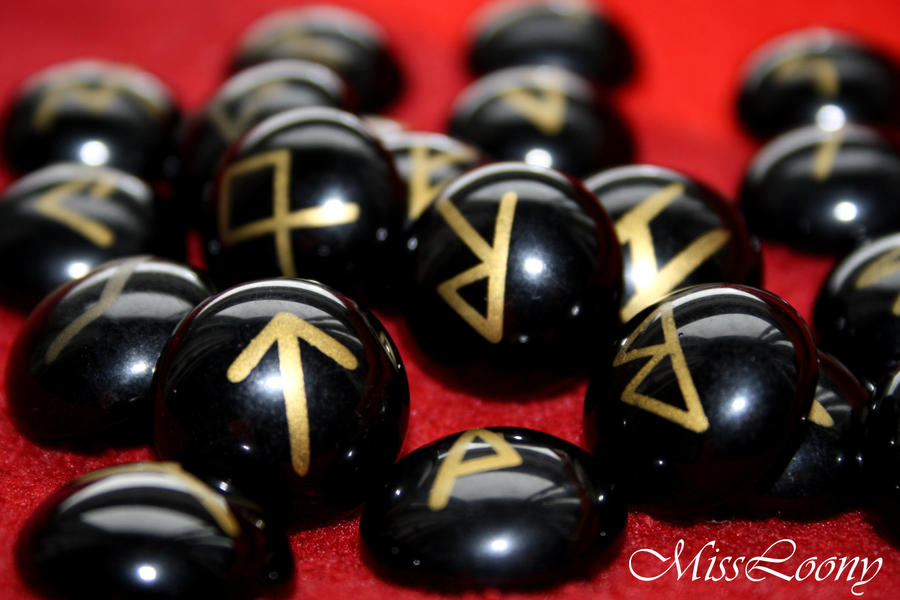
Note: The image was taken by MissLoony.
Most
of my readers were expecting this subject the wednesday the 14th of September, but i couldn't do it, it was my Father's Birthday, but from now on, every wednesday i will post and talk about a new rune till it comes to an end, i hope you enjoy and learn about each rune and its healing power. This is the Introduction to them. Stay tuned, for every wednesday there will be a new rune to talk about.

The runic alphabets are a set of related alphabets using letters known as runes to write various Germanic languages before the adoption of the Latin alphabet and for specialized purposes thereafter. The Scandinavian variants are also known as futhark (or fuþark, derived from their first six letters of the alphabet: F, U, Þ, A, R, and K).

In the nordic mythology it is said, that Odin
hanged in a branch of Yggdrasil for nine days and nights, bleeding, he passed into the other side ( as i've written in the Post about sleipnir ) to know the secret and magic of the Runes.

This is a brief introduction to the runes, the alphabet used by the germanic and scadinavian people, the runes were also adopted by many others throughout Europe, it has survived till today, but the runes have more to say about them and their hidden powers, that many talk about but only few realy know, every wednesday i will post and write about a rune, till it reaches an end, stay tuned if you want to learn more about the runes, thank you for your time, Farewell.