Showing posts with label viking. Show all posts
Showing posts with label viking. Show all posts
Viking Warrior-Women existed?
You can watch the video about this subject in here: [Viking Warrior-Women]
As I’ve told you before, there are historical facts and then historical facts proven by sciences. There was always this idea of Viking women fighting alongside men; fearsome female warriors in poetry and in the sagas. For instance, we have the famous Freydís Eiríksdóttir, the daughter of Erik the Red. She appears in the Sagas of the Greenlanders as a fearsome warrior, with masculine physical features, and a lot of people died due to her schemes, and she even fought the North-American natives. But there were no certainties that she even existed. We have always heard about warrior women in the ancient Scandinavian societies, especially during the Viking Age, but the truth is, there were no palpable evidences that they were real, that the women in these societies were warriors or could be warriors, it’s like when you have an idea, you spread it so much that all of a sudden everyone is talking about it as if it were true and becomes a fact. But fortunately nowadays, and this is a recent discovery, there are physical evidences that viking warrior women really existed, all thanks to archaeology, physical anthropology and genetics. So now we can say with certainty that women in ancient Scandinavian societies could be warriors.
Women were very active within ancient Scandinavian societies. For instance, unlike Iceland where men were more active in activities related to witchcraft, especially Galdr, in mainland Scandinavia, Seidr – witchcraft, rune-magic, divination and so on – was the province of women. Women also took care of the household and the farmstead when men were away raiding, they could even get divorced, and if their husband was killed they could take their sit in the Thing (the assembly of the community), having a very active role in politics. But when there were kids to take care of, their mothers were in charge of teaching them the arts of war. Mothers would teach their kids how to use the bow and arrow, the shield, sword, axe and spear - so women knew the Scandinavian medieval martial arts. With this knowledge in fighting and using weapons, why not try their luck like men? I’m sure taking care of the farmstead was a dull business, being at the assembly probably quite boring, so why not explore the world, discover new places, meet new people and kill them and rob them of their properties?
Archaeological evidences of warrior graves are numerous, especially during the Viking Age period of Northern Europe. And in the Viking town of Birka, in nowadays Sweden, was the key centre of trading between the 8th and 10th centuries. There is a great number of graves distributed over large burial grounds encircling the town area. Of course, graves not only for warriors but other town's folk, but there is a specific area just for the garrison of this town, and in this area were found the deceased warriors. The graves in this area contained all manner of objects linked to the activities of warriors. The grave goods included swords, axes, spears, armour-piercing arrows, battle knifes, shields, well . . . the complete equipment of professional warriors. Some graves even had horses, and horses already indicate high-ranking officers. One of these high-ranking officers was a woman, scientists came to the conclusion after osteological and genetic tests.
Now the question is, do weapons found in graves necessarily determine a warrior? There is a variety of archaeological findings of viking-women buried with weapons and they weren't
necessarily warriors. But this one not only had all the equipment a warrior needs, also had horses. Two horses, as I've said. Horses weren't easy to come by, and it was extremely expensive to own one horse, let alone two. Horses were also chosen to be the sacrificed animals when it came to funerary rituals for someone of great importance, extreme importance really. But that depends on the context. In this context, these two horses show us that they were worthy of an individual with responsibilities concerning strategy and battle tactics. Of course there is the Oseberg ship case, where two women were buried with a great number of horses, but on that context we are in the presence of something completely different and unique, which I would love to talk about on another video someday.
And now you ask, what about signs of trauma in the skeleton which indicate that the individual was a warrior? Well I must say that the skeletal remains of this female warrior did not exhibit signs of trauma. But weapon-related wounds are not that common, actually, during the Viking Age, traces of violent trauma are more common in mass burials, so it's more likely to find graves for a single warrior with little or no traces of trauma, and not every weapon hits the bones and leaves a mark, we have to take in mind that there is a lot of flesh and muscle to slice and people can die from it.
Well, this goes beyond my professional knowledge, as an archaeologist I know a bit of theoretical physical anthropology and a tiny bit of genetics, but that work is left to the scientists who really know about this stuff, and they say this skeleton belonged to a woman and we can be certain it did. Now, is this the only female warrior of the ancient Scandinavian society? Of course not. Till now the idea was that men were the warriors and no one really went to the trouble of properly study the osteological remains to see the gender. This woman was not only a warrior, but a highranking officer, so if women could have such a high statues in the military field, certainly they could be warriors. In conclusion, female Viking warriors were part of a society that dominated from the 8th to the 10th century of northern Europe and now with certainty we can say that women were full members of this society, being very active in every field.
Norway’s First Coin
Currency has been around for quite some time, but in the cold northern European countries it took some time to arrive. In truth, everything from the south took long enough to reach the north and vice versa.
In the year of 995, of the Common Era, when Olav Tryggvason became King of Norway (some call him Viking King but that isn't the correct title), silver coins changed their appearance and the king's own name started to be carved in coins. "Onlaf Rex Nor", meaning "Olav, King of the Norwegians", this started to be printed in coins. Of course coins were not something invented by Tryggvason, particular these coins with religious (christian) motifs.
During Tryggvason's time, Ethelred II was the king of England. Viking raids were still common, but things were changing, and not only landlords and nobles were going "viking", but also kings. Raiding became a great source of income to the northern peoples of Europe, which arose their economy imensily. Raiding was also to show one's power and right to rule, so above everything else, raiding was the legitimate claim to govern. So king Ethelred II had to face both the armies of King Olav Tryggvason and King Svend Tveskæg of Denmark. Suffice to say that the king of Englad had to pay a large amount of money to sue for peace. In the spring of the year of 995, Olav Tryggvason returned home with a great amount of Anglo-Saxon Crux coins in his luggage; a lot of coins already with the christian motifs well printed, marking the faith of those people.
Olaf/Olav Tryggvason was King of Norway from 995 to 1000 A.D.. Olav was the major "character" in the conversion of the Norse to the new faith (Christianity). He is known for this and somehow exalted by historians for being the key to the converstion of the northern pagans into christianity. However, such conversion was brutal, horrible even, with many gruesome accounts of torture and the most abominable, enduring and painful ways to kill in the name of religion and forceble convertion. Nonetheless, he was the reason for the first christian coins in Norway, and probably the introduction of hard currency, because before that cattle was the measurament of wealth.
Denmark’s new stash of Viking gold
It was found in Denmark, in a fiel near Vejen, a stash composed of seven wonderfully crafted bracelets, six of which are made out of gold, and one of silver.
The bracelets were handed over to the Sønderskov museum, and I must point out that this treasure was found by amateurs, and just like any responsable adult, the people in question delivered the treasure to their rightful place. Anyway - a little bit of personal thoughts on the matter - the bracelets date back to 900AD, and are decorated in a style typical to Viking jewelry weared by nobility or with high-status in society.
It is important to take in mind that the so called Viking Age is actually the "silver age" when it comes to hoards. The vast majority of them contain only silver. If there is gold, it is always a small part, which isn't the case in this specific finding, since objects made out of gold are the majority of this hoard.
| Keywords: Archaeology, Denmark, European History, Sønderskov, Treasure, Vejen, viking, Viking Treasure

The Viking Priests and Priestesses of Sandvika
In the year of 1963, a burial ground with 24 graves inside the bay of Sandvika on the eastern side of the island of Jøa, in Central Norway, were discovered. The bodies were buried in a sitting position, and after a close analyses the dating of the remains go back to the years 650 to 1000 AD. The unusual burial caracteristics showned that these northmen belonged to a specific group of people within the Viking society.
Unlike other graves from the Viking Age, this graveyard was unknown to the human sight, because the bodies were not placed inside a burial mound that is could be clearly visible in the terrain, or marked in any other way but rune stones or anything of that kind. These Vikings were lowered into funnel-shaped shell sand holes. This burial ground is unique in Scandinavia, and these people are the only ones to have ever been found like this - in a sitting position. So why were they placed like this?
Lets make a quick analyses of the bodies. The people in question must have been dead for at least twenty-four hours so that rigor mortis has made it possible to shape the body into a sitting position. Also, it must have been very difficult to dig out chairs in the porous shell sand, so to go into all this trouble these people were not common folk amongst their community. There is another aspect which must be taken into consideration. In 14 of the 24 graves there were found skeletons and skeletal remains; the other 10 graves were simply empty. The remains were identify has belonging to 7 women and 4 men. Analysis shows that the women in question reached an average age of 47 years. (It has only been possible to determine the age of one of the men, and he died at the age of 40.)
The women had an average height of 157.2 centimeters (5ft 2in), and the men 162.6 centimeters (5ft 4in), which is much lower than the normal height for this period. The men were as much as 10 centimeters (3.9in) lower than the average for the Viking Age (172.6 cm / 5ft 8in).
The dating of the artifacts found here, shows that these Vikings were buried fully clothed in the period between 650 and 1000 AD, (from the Merovingian period to the end of the Viking Age), and it seems like the burial custom ended when Christianity was forced with swords upon the Norse society.
Today, on the other side of the small river Hovselva (the Hof River) is the Hov (Hof) farm located in the northeast – indicating that there was a pagan temple located close to the burial ground. In all of the 24 graves there were found remnants of bonfires, so it is natural to assume that there must have been some kind of ritual that includes bonfire in connection with the funeral.
Another peculiarity is that about half of the bodies were facing north-northeast (facing the Hof itself) and half to the south-southeast. No one was facing directly east and only one body was facing directly to the west. As many as ten knifes were found in 9 different graves. They vary in length, but none of them has a blade more than 20 centimeters and consequently have not been used as Viking combat weapons. The individuals they belonged to must have used these knives for a very specific purpose. There were no other weapons found inside the graves, which is unusual for the Viking Age. However, there were also found beads, brooches, finger rings and keys, but there is no repeating pattern.
Summarizing: these people were buried in a small area close to a heathen Hof, and the dead were put down in a sitting position. There was no marking of the graves but they may have been marked with ornamental shrubs or flowers; almost all of the graves contain remnants of bonfire, and there are no traces of weapons. However, there were found many “regular” cut knives; the bodies were facing north-northeast and south-southeast. No one was facing directly towards the east.
So who were these Vikings? They might have been “hovgydjer” - pagan priests and priestesses. The knives might have been used for sacrifice, or were the tools of these priests and priestesses. If thise is the case, it is very important for the understandment of the people who practiced the magical arts. It was common in Viking Age society that the only ones to practice sorcery, witchcraft, spell-work, divination and so on, were only women. But in this community it might have been different; it's quite plausable that men also did this kind of work.
We also have to take into consideration that these specific men were very small, and possibly very fragile. So it may have been that the community found a way to give them a purpose, a trade, a way to help the community since they might have been to fragile for other harduous works. Or maybe we are in the presence of an old Shamanic custome, where men who had certain feminine qualities were revered and worked as spiritual guides. Well, this remains a mystery.
| Keywords: Archaeology, European History, Hof, Hov, hovgydjer., Hovselva, Jøa, Northern Pagan Traditions, Norway, Pagan Temple, Sandvika, skeleton, skeletons, viking, Viking Hof, Viking Hov, vikings
Dalecarlian runes
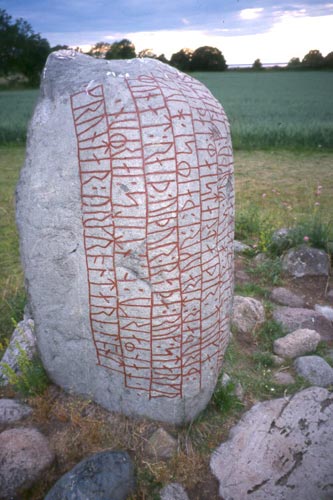
We usually associate runes with the Vikings, although these symbols have been an early form of writing spread all over Europe since the late Bronze Age (possibly even before that). Our ancestors started to produce geometrical symbols; they perfected them, simplify them, until we start to see in archaeological context the early forms of what would be the runes. This form of writing soon came to an end when Romans started to conquer Europe and the latin alphabet replaced the old forms of written language. But far in the north the runes remained till late, due to the fact that romans had little influence, if any, in those regions. However, christianity eventually reached Scandinavia during the middle ages, and it was thought that the Vikings might have been the last people to use the runes in a daily basis, and that the runes continue to be used only for magical purposes. But in the hidden deapths of Scandinavia, people still used the runes as far as 100 years ago.
The runic alphabet was the dominant written language in Northern Europe until the advent of Christianity in the 9th and 10th centuries introduced the Latin alphabet. By the 15th century the Latin alphabet had almost wiped out the use of runes. But here, in Älvdalen, the runes remained very much in use.
In Älvdalen, near Dalarna, in western Sweden, the local population continued to use the runes for centuries after the ancient written language had been abandoned by the rest of Scandinavia. Until the early 20th century the runes were still used there. The inhabitants of this region retained their very special language - Elfdalian - which is an other completely different language apart modern swedish (an unique old Norse tongue).
Here is an example of the runes used till modern days:
 |
| Illustration from: [Arakun/Wikimedia Commons] |
As you can see, the runes of Älvdalen - dalrunerne - are reminiscent of those used on runes stones in countries such as Denmark, Norway, Sweden, etc., but there are a number of differences. Dalrunerne developed over time, influenced partially by the Latin alphabet. The use of runes in Scandinavia gradually ceased during the 15th century. Although there were some areas of Gotland, in Sweden, and in Iceland, where the rune tradition survived until the 17th century, but in Älvdalen their use was widespread until the early 20th century.
The runes in Älvdalen were most commonly found on houses and inscribed in furniture, and were also engraved into "message blades" which were sticks of wood that were circulated among the farms in the area. It's really interesting to see that the people who herded the cattle up in the mountains would write messages to each other in runes.
This wonderful linguistic and traditional treasure remained till late due to the isolation of this region. A place deep in the Swedish forests and mountain ranges, hard to get into. While the rest of Scandinavia, and Europe, the Latin alphabet and Germanic dialects spread and gave way to the modern languages of the European linguistic-branch, in Älvdalen a little bit of the past remained frozen in time.
| Keywords: Älvdalen, Dalarna, Dalecarlian, Dalecarlian runes, dalrunerne, Elfdalian, European History, Norse, Northern Pagan Traditions, Old Norse, Runes, scandinavia, Sweden, viking, vikings
Viking Cats - Onward to conquer!
We know that cats have already conquered the internet with their cuteness and silly behaviour, but in the past they have also conquered lands! Well . . . not likely, but the latest and largest genetic study of cats revealed how our fluffy friends spread across Europe, Asia, and Africa, and even sailed aboard Viking ships.
The world’s first large study into ancient cat DNA reveals that the earliest ancestors of these furry fellows reached Eurasia and Africa at the same time as early farmers (during the Neolithic), and were later helped by sailors, including the Vikings. It was already known that cats reached the shores of Europe through the mediterranian sea during the Bronze Age, but now this study shows that cats have landed in European soils in a much distant past.
Scientists sequenced the DNA from 290 cats from more than 30 archaeological excavations throughout Europe, the Middle East and Africa, including the remains of a cat in a Viking grave in northern Germany.
But why were the Vikings so important in spreading these feline conquerors? Well, cats have their importance in Norse mythology, and were often connected to specific deities. Of course I will mention the goddess Freyja, notoriously known as the goddess of love. In the Norse Mythology she has two cats that pull her carriage. And, of course, there is that one tale when Thor visited Utgard and he tried to lift the gigantic Utgard-Loki’s cat. It turned out to be a serpent, the Midgard Serpent, which not even Thor could lift; a spell was at work in this tale. Suffice to say, in this tale as well as Freyja's cats, there is a connection between cats and magic, because Freyja herself is also one of the few Norse goddesses to be closely connected to magic and Seiðr work - a type of sorcery which was practiced in Norse society, closely related to shamanic practices which I will not delve much into the subject because we are talking about cats dear friends.
There are other tales about cats in the Norse mythology, so it's safe to say Vikings cared about their cats because even the gods had them. When cultures include a certain animal in their mythologies, or in their cultural and traditional code which defines them as a people, it shows us that these animals where very important to these societies, which is why they gained a connection with the gods in the first place.
Anyhow, in this new study, samples were taken from the remains of cats dating to as recently as the 18th century and as far back as the early Stone Age. Around 8,900 to 3,900 years ago, when Europeans had not yet adopted farming and still led a hunter-gatherer lifestyle.
It seems that cats spread throughout the old world in two waves. The first wave arrived with the earliest farmers in the eastern Mediterranean, as indicated by the discovery of 9,500 years old graves in Cyprus. It contained the remains of a cat and suggests that the relationship between humans and cats dates all the way back to the early days of the Neolithic period. The second wave took place thousands of years later as cats from Egypt quickly spread to the rest of Africa and Asia. Their genetic markers were discovered in cats from Bulgaria, Turkey, and sub-Saharan Africa that also date to around the same time.
It is possible that the friendship between people and cats arose as early farmers began to store grain. The grain attracted rodents, which in turn attracted wild cats, and so began the mutually beneficial relationship with our feline friends. Yes, cats to care of rats and so the grain was safe. This is exactly like the relationship of humans with early dogs. The domestication of wolves and wild canine creatures created the best friend humans could ever have - a guardian to ward of dangerous animals and other predators. In a subtle way, cats also made their way towards humans, showing their abilities and their usefulness, thus becoming equally important. Cats also helped to keep down the numbers of rats and mice on ships, during long voyages at sea, so it's perfectly understand why cats were brought by sailors.
A Viking grave, discovered in northern Germany, is believed to date back to somewhere between the 8th to 11th century CE, and there was a cat in it which helped in the study. A search in the Natural History Museum of Denmark database of archaeological finds showned that there is no doubt that cats were commonplace inthe Iron Age and Viking Age of Denmark and that people commonly wore cat skins by the late Viking Age.
With certainty, there were domestic cats back then, in the Viking society, because of their size which is related to the type of life of a household cat. Wild cats are larger and their bone-structure is much different, whilst dosmetic cats are smaller and are nowehre near the size of their wild cousins.
According to archaeological research there are also evidences that cats made it to Greenland, which points to the first Europeans to step into those lands - Vikings. Vikings carried cats in their longships probably for the same reason as everybody else, but maybe also because their connection to the goddess Freyja. Mayhaps it was easiler to bring domesticated creatures to a new land, rather than other animals more wild in nature and also connected to magic.
| Keywords: Archaeology, Cats, European History, Freyja, Gods and Mythology, Norse Mythology, Northern Pagan Traditions, Sailors, viking, Viking Age
Viking children and the art of war
We know from historical records, the norse sagas and archaeological evidence, that children (especially boys) were often trained, almost since birth, to wield a sword, axe, strengthen their muscles to lift a shield and start to practice the bow and arrow at a very early age to widen their shoulds and backs during the process of growth to be able to push the bow-string as further back as they could. It was completly understandable that these people were so violent in nature because the world of violence was upon them as soon as they were able to speak the first words.
Women also knew how to fight. It isn't strange to us to hear that from viking women; it's perfectly normal to accept warrior-women in viking society during the medieval ages, and strange when we hear of other warrior-women from other societies of the time. They would accompany men in their raids, but before that, womem were left behind to take care of their properties and to take care of the children. They had an important role in continue to educate the children in the art of war because someone had to protect their properties when mom and dad were away.
It was instilled in the mind of boys that they would only become real men through warfare. Blood and honor, bravery and strength, that would get you in Valhalla among the best of the best, the bravest warriors. There are historical reports and even archaeological evidences of this - children killing children - sometimes a youngling no more than twelve winters of age capable of killing a fifteen-year-old. According to the Eddic poem for instance, children learned a variety of combat skills and techniques, including fighting with your bare hands.
Even three year-old boys played the war game with wooden swords and throwing spears covered by a piece of leather so that they should not hurt themselves or others. As children grew older, they could be lucky and get real weapons of iron, forged in a child’s size. Archaeologists have found several such weapons, including a small sword and an ax in a child’s grave. Besides playing with weapons, wrestling was one of the most popular games and something boys were doing throughout the year. It was a type of martial arts of the viking society. Through wrestling matches, they practiced speed and agility, and the training was a good preparation for future close combat situations.
Through this fighting technique children also learned game rules and discipline. The Children had to promise that they would not hurt each other intentionally during play, and their word meant more than a thousand contracts, it was their honor that was at stake and honor meant everything in the eyes of men and gods. These rules were taken very seriously and strictly enforced. Those who broke the rules, committed “níð” and were often called “níðingr” – one of the worst epithets in the Viking Age. being a “níð” implied the loss of honour and it was the status of a villain. It meant a person had no honor, was a coward, was nothing at all in the sight of every living thing. Much like a "Vargr" which was the term given to an outlaw, a criminal, but in that case that person would become a "wolf" and lived in the wilderness, unable to return to society or else could be killed on sight by anyone since he was a threat - a wolf. While a “níð” could still live amongst men but would forever be stigmatized and people would always treat that person with indiference.
But not everything during children's training was violent and terrible. When it was snowing, children built ramparts and fortresses that they used as battle arenas. Snowball fighting was not only entertaining but also effective training in siege techniques and different throwing skills.
Most important of all this was that the young ones learned about the warrior society’s code of honor. The Norsemen were convinced that a number of Norns (goddesses of fate) spun the threads of life, and that every human life was predestined. No man could change his destiny and only the brave warrior would come to Valhalla. A Viking warrior therefore had to fight like a man and die like a man if the gods had decided it. Even if some did not believe that their fate was sealed, there was always Valhalla, the great hall of the slain where only the most honorable and bravest warriors would go after death to be with the All-father Odin. That was their ultimate goal, and to achieve that one had to die with sword in hand so to speak.
It was easy for a warrior soeciety to understand the implications of battle. Either one will fall, or survives, therefore the only thing to do was facing every trial with bravery because everything is predetermined by the Norns and nothing could change that. Nothing could kill them if their time had not yet come, and no one can save the one who is destined to die. Dying in battle was the most honorable thing a Viking could achieve, and also the ability to plunder was highly respected. Ordinary thefts were considered cowardly actions, but plunder took skill and bravery; taking riches highly defended by other skillful warriors was indeed something to praise.
Viking boys had to prove that they had the courage and skills before they were considered as grownups. If they belonged to a powerful family, they could prove themselves worthy by participating in a battle or go on Viking. The sagas mention that Olaf Tryggvason (963 to 1000 BCE) killed his first man when he was nine years old. Olaf Haraldsson (995 to 29 July of 1030 BCE), (who later became Olaf the Holy), went on Viking when he was twelve years old.
Archaeology: A viking blacksmith
A thousand years ago, more or less, a norse blacksmith reached the end of his life-journey and at his funeral rites, his tools were buried with him. Now, archaeology found his burial place and the artefacts buried with him. The findings give us insight into the work and status of a blacksmith in the viking society of old.
The grave was composed of several layers. It seems, according to the archaeologists , that the placement of the artefacts in the grave signify a relative status. At the top it has been found the blacksmith tools. An axe was also found, along with a sword and some agricultural implements. Deeper down were the blacksmith’s personal items, including a razor, scissors (for trimming his beard, perhaps), tweezers, a frying pan and a poker. The grave contained about sixty artefacts. At the very bottom it was found the cremated remains of a human being – it was the blacksmith, of course. There were other personal items; some beads that had been attached to his clothing and a comb made of bone.
It may be possible that the blacksmith's contemporaries wished to show how skilful he was in his work by including such an extensive amount of objects; he might have forged many of these tools himself even.
It is interesting to see that during the Viking Age, people still had great respect for blacksmiths. Tamers of fire, who could create objects controlling this wild and dangerous element, molding metal and making a perfect union between earth (the metals it gives), fire, and water and air (which are also needed while forging). The use of the four elements by one single person, and the control of those same elements; blacksmiths in old times must have been seen like some kind of sorcerers.
The joy of creating objects, by controlling the elements and using both strength and delicacy, must be a wonderful therapy.
| Keywords: Archaeology, blacksmith, Elements, Elements and Natural Therapies, European History, findings, forge, tools, viking, viking blacksmith
Scandinavian Religious Leadership during the Viking Age
Unlike our European societies after christianisation, whose religious leadership is held by the church, in the scandinavian societies things were different and religion was no less important to them as it was for the early christians. Religious ceremonies and its administration was performed by the local leaders of the communities. For instance, a Jarl* of a farmstead took on the duties of administration, not only in the Thing*, but also conducting ceremonies related religion, the seasons and harvest times, new births, accessions, deaths, and so on.
The Jarls were of course very powerful and had a very active contribution in their communities. But not only Jarls had the power to conduct ceremonies and such. There were the Hersar (sing. Hersir). The "landed men"; local chieftains with family lands and many tenants and dependants, who preside over their district Thing. Of course the Hersar were more busy in increasing their wealth, and often led raids.
Women also had a very important and active role when it came to religious administration and other related actions. Many performed acts such as telling the future, healing the sick, and worked as the shaman/seeress of the local community. Women were seen as the keepers of the magic arts and able to communicate with divinities and otherworld spirits. Of course not all women were wielders of magic, but magic was their domain. Obviously there were men practicing the magic arts, but they were too few and were seen as effeminate for their unmanly behavior.
*Jarl - Powerful regional magnates. The highest men in the land under the king. Some Jarls were as powerful and wealthier as their kings, and had bands of warriors which rivaled the size of the kings' own armies. Many led raids to increase their status and wealth.
*Thing - and assembly where laws were discussed.
| Keywords: European History, Leadership, Northern Pagan Traditions, religion, scandinavia, viking, vikings
The Viking method of execution - the blood eagle - may be a mistranslation
The blood eagle as a Viking method of executing a person, may be the result of mistranslations and not historically accurate.
The execution method of the blood eagle in which victims were sliced open along the spine, had their ribs snapped open so it would look like wings, the lungs pulled out and salt poured in, may be a mistranslation of the Icelandic poet Sigvat Thordarson’s famous poem - Knútsdrápa. The poem is about Ragnar Hair-Breeches’s sons slaying King Ella of Northumbria in revenge. The stanza in question has been translated as both “Ivar caused the eagle to cut the back of Ella” and “Ivar cut the eagle on the back of Ella.” However, only the first translation makes literary and historical sense, as it fits in with the unique structure of the Icelandic poetry as well as the tradition of describing a slaughter as providing carrion for birds. The second translation led to a 14th-century interpretation that still exists today of the Vikings enacting a particularly horrid form of retribution.
This dreadful description of one of the methods used by the Vikings to kill a person, lasted to our days as the correct form of translation in an attempt to mark the Vikings as the barbarian bloodthirsty hordes the priests and monks believed them to be. The victims of the Vikings gave them a terrible reputation and later on the historical documentations writen about them which have survived to our days, were made centuries later when the Vikings were no more and the truth about such events had been altered from writer to writer.
Valknut - A Norse Symbol
The Valknut is probably the most known and used symbol (as well as the Mjölnir) by the neo-pagans who follow and practice the old Norse pagan traditions. However, most people don't know it's meaning, sadly. The word Valknut is a neologism, created in modern times, formed by the combination of "valr" (the dead or the slain" and knut (knot). This symbol has many connections with the other symbols I have written before, this is a symbol of three interconnected triangles. These triangles may be joined in two ways, and I will place images below.
It can either be as Borromean:

or Unicursal:

Know that other types of Valknuts that you may encounter, different from these two, were never used in original Viking ornaments. Only the two designs above are genuine Viking Valknuts, keep that in mind. The Borromean triangles type can be seen in the Stora Hammer Rune Stone (below).

Right above the Valknut, we can see a raven, obviously Odin's symbol. Below the symbol, probably a burial scene or even a burial mound, it is obvious that it is something connected with death. A dead person, probably a warrior, is placed there by a figure with a spear and accompanied by another raven, probably Odin himself, since the two ravens are his symbol and also the spear, Gungnir, his famous weapon. To the left, it seems that there is someone hanged on the tree, which is another symbol for Odin, for he is also called Hangadróttinn (Lord of the hanged) and Hangatýr (God of the hanged), but I am not sure if that is a hanged person, so I leave that to the experts in Rune stones. One thing is certain, all these symbols are around the Valknut, which is in the center of all this scene, this means that all the symbols point to death and that Odin is also the god of the slain warriors.
The unicursal type of valknut (which can be drawn with one stroke) appears on Tängelgarda stone (below):

Other instances of the valknut in Viking ornaments are Lärbro stone, River Nene ring and a bedpost found on the Oseberg ship.
The Valknut as a symbol linked to the slain, isn't the only possible interpretation/explanation. This symbol is also caled Hrungnir’s heart, based on the descripion found in the Prose Edda.
It isn't clear the true function and meaning og the Valknut. However we do know that it is also linked to the slain and taht the number three is a very common magic symbol in many cultures. In Scandinavian context three multiplied by three might designate the nine worlds, which are united by the Yggdrasil tree. In modern times, the Valknut, such as the Triquetra and also the Horn Triskelion whih I have written before in another post, is often interpreted as a symbol pointing to heathen convictions.
Princess Piki Part IV
Princess Piki Part IV
Upon arriving to the banks of the Lake Gladtló, where trees sink their feet in the deep waters, Niniär sat on the earthless ground made only out of roots that stretched far down below into the mirrored Lake. Sadness was a cruel companion, but she had her horse by her side and both rode northeast to meet the waterfalls of the river Urodum which fed the lake. As they went upwards, the lake was left behind in the valley. Wan the moon came, reflecting upon Niniär's skin, and down below the waters of the lake were so clear that mirrored the sky in all its splendor, it was unclear which one was the real roof of the world. Swans flew over it and landed on the stars. The sound of the cascade falling down into the lake broke the silent night. The roaring waters fled from the mountains in such a hurry and devastating strength that Niniär and her horse had to hasten their pace due north to find a narrower space and built their path into the other side. The crossover wasn't far off, it was where two rivers met and became one single earth's vein. Attached to Urodum was one of the streams of the widest and largest rivers of Nárlond, the Telssian River. It was here where both met, that Niniär and her horse went through. The water was only a few inches above the waist. After arriving to the other side, the two companions followed the single stream of Urodum that ran southeast to disembogue in the great inland sea of Fhör. It was an hard journey of at least one hundred and sixty miles. They constantly stopped to rest and gather food, always southwards along the eastern side of the river, for its western side broke in two and passed too close to dangerous marshes shrouded in mist, as far as the eye could see. A four day's journey to encounter the uncertain presence of anyone living near the coastal region of Fhör.
Niniär and her horse weren't hindered during their journey towards the inland sea of Fhör. They had been blessed with bright days along their road, and the chirping of birds soften their mood. Deep and in secret, Niniär's mind wandered, always doubtful and filled with uncertainty for what might be found at the road's end. The continuous pace of the horse through grass and the sound it made, cradled Niniär, but she woke up from her daydreaming as the sound changed. The ground also had changed, it was rocky, filled with dust and a redish-brown soil. From the south, sweeping across the land, a salty fragrance and the sound of surf endlessly rolling upon the beaches. Only forty miles to gallop till they could set their feet in the northern cliffs of Fhör that stretched eastwards for at least seventy miles, then breaking and sinking in a vast woodland and rising once more for another fifty miles. Of such likeness were these, reminiscent of great walls made out of clay. The waves bashing against the cliffs were like the stirring voices of thunders. The sea below reflected the sun and the beaches with golden sand glimmered. The view might be pleasant to the eye and comforting to the heart, but the rocky southern slopes near the waters of the inland sea of Fhör hid fiends of savage fury, covered with shiny scales, and the sun was deadly in the barren lands around it.
A new dawn was breaking, the grey light behind the clouds. The wind was flowing and rain from above shuffling the dirt in the ground, turning it into mud. An heavy rain fell akin to the waters of Fhör, surging, breaking and grinding. Shedding from the high heavens it tore the path that Niniär and her horse left behind, blending it with the rest of the landscape. Leaping from the soil, fragrant scents, and poor Niniär unguarded did not hear nor heeded the strange shadows coming her way, coming out of the bushes like black phantoms, winding their way in her direction. Beneath the horse's hooves the ground sunked in a muddy puddle, and the earth itself enfolded the horse and Niniär.
To be continued...
Arith Härger
║▌│█│║▌║││█║▌│║█║║▌│█│║▌║││█║▌│║█║Cσρуяιgнт © 2014™
Note: If you have any questions for me or if you want to see my artistic works, check out my Facebook page and make a Like if you can by following this link --> http://www.facebook.com/ArithHarger
| Keywords: Arith Härger, creatures, Dwarf, dwarves, Fantasy, Fiction, fiends, Harger, horse, monsters, My Poetry and Prose Works, Mythology, nature, Princess Piki, sea, short story, Stories, viking, Vikingwidunder, wolves
The Triskell and Triquetra
In another post, I talked about the Fylfot symbol, a symbolism of the triade of gods and today in this post I will continue with another symbol of that same triade, and also the Norns.
The Triskell is attributed to magical work such as reading the runes and as such, it is alsp connected with the Norns, the goddesses of fate.
The first branch of Triskell (Odin) describes the essence and the ocult meaning. The second branch on the right (Vili) is the principle of movement, energy and life tendencies. The third branch of the left (Vé) reveals the materialization of these impulses in the reality of our body and the world around us.
The importance of numbers in ancient religions has always been very present, as in here we see that the number three simbolizes the wisdom we can all obtain. However, the number nine is also present in the religions of northern Europe (3x3 = 9) which symbolizes that which is beyond our understanding, this is the number that symbolizes a consciousness beyond our mortal body, symbolizes the initiatory process of traveling to the other world as Odin did in his sacrifice hanging on the world tree Yggdrasil.
An older spirituality, the number three symbolized three different worlds, three realities or different planes of consciousness, the upper world, the middle world and the underworld, the foundations of a spiritual work, the foundations of shamanism. We also note this triade with the three types of guardians in the Norse mythology, Heimdall guards the Bifrost Bridge, Modgud the bridge that connects Helheim and Thor protects Asgard.
Retreating further into the origins of life according to the Norse mythology, also in the beginning there were only three planes. Niflheim and Muspelheim and Ginnungagap which was also a form of primeval life. Only then was it possible the appearance of the first signs of life through Ymir and Audhumbla.
Thus we see that the number three instilled in the Nordic symbolism, give us the understanding that this number is the number creator of all life forms, an energy catalyst.
The triquetra is also a Norse symbol closely connected with the Valknut and the Triskelion Horn. There are thousands of artifacts with this symbol in ornaments which have been found in Gnezdilovo ( in Russia ) all the way to York ( in England).
Initially this word designated any three-cornered figures, but now it is applied to the shape formed by three interlocked semicircles at the place where three circles would overlap.
The Triquetra was also used by the Christians to convey their own religious content. As an example, the Triquetra that was struck on the coins by the Christian Norse kings of York, was probably already reinterpreted by York Vikings in the Christian perspective. The same may apply to the silver penny issued by Harald Hardrade (king of Norway from 1047 to 1066).
Note: If you have any questions for me or if you want to see my artistic works, check out my Facebook page and make a Like if you can by following this link --> http://www.facebook.com/ArithHarger
| Keywords: Audhumbla, European History, Ginnungagap, muspelheim, Niflheim, Norns, Norse, Northern Pagan Traditions, Odin, Symbols, Triquetra, Triskell, viking, Yggdrasil, Ymir
Thor’s Hammer
Speaking of Norse symbols, Thor's Hammer or Mjölnir is one of the most used symbols of all time, I dare to say that it is more used nowadays than during the Viking Age, unfortunately most people use it and don't know its true meaning, they just use it because it is cool and most bands they like also use one of those.
Mjölnir is the weapon of the Thunder God Thor, which initially was thought to be made of stone, but in truth it was made out of iron, forged by the Svartálfar or black elves, along with the help of the dvergar or duergar (dwarves) named Sindri and Brokkr.
Thor's weapon in the myths is a magical axe or hammer when thrown with the objective of destroying its enemies, it comes back to Thor's hands like a boomerang, it has also the capability of becoming so small that can be carried under the clothes. Mjölnir is to Thor what Gungnir (the spear) is to Odin, it is the very symbol of the god of thunder and his power, it is a weapon that all the enemies of this great god fear the most, especially the Jötnar, the giants of the Norse mythology. Most enemies try to lure Thor into their territories and somehow steal his hammer and Megingjörð, Thor's belt of strength and power. During the Viking Age, miniature pendant replicas of Thor’s hammer were very popular and often used by all in Scandinavia. In Iceland its variant was cross-shaped, while Thor’s hammers from Sweden and Norway tended to be made with an arrow or T shape. According to some researchers, the swastika shape found in East Anglia and Kent before Christianization, may be a variant of the same symbol. In Old Norse the name of Thor’s hammer is spelled either mjǫlnir or mjǫllnir. It is thought to be etymologically related to the English word mill and meal "to crush". Another version states it is related to the Russian word молния and the Welsh mellt, both meaning ‘lightning’. Mjölnir is usually interpreted as meaning "That which smashes", derived from the verb mölva "To smash". "Moer" which is one of the Portuguese words that survived the Germanic and Norse influence in the country also means "to crush" or " "to grind" and also "mill".
Many modern Thor’s hammer pendants try to feature the word Mjollnir in the Elder Futhark runes, simply replacing each letter with a corresponding rune. The procedure is incorrect. Mjolnir is an Old Norse word. Old Norse developed in the 8th century. Due to its difference as compared to its earlier form, Proto-Norse, Vikings were to reform their runic writing system. As a result, they adopted the Younger Futhark. By the end of the 8th century the Elder Futhark was not in use any more. If we were to write the name of Thor’s hammer in the Elder Futhark runes, we would have to reconstruct it in Proto-Norse.
It is important to know that this symbol is a symbol of power, protection and fertility, most people who aren't heathens, or anyother pagans who practice the old Norse beliefs tend to label Thor's hammer as a symbol of hatred, racism and fear, which obviously isn't.
I always wear a Mjölnir made of Ox bone, it was a gift given to me by my girlfriend.
Note: If you have any questions for me or if you want to see my artistic works, check out my Facebook page and make a Like if you can by following this link --> http://www.facebook.com/ArithHarger
Póvoa de Varzim - Norse Pagan Past
It's no news that the Norse and Germanic culture spread so wildly throughout Europe and even got to Portugal, the last European country by the sea. For obvious reasons Portugal as always been the favorite European country for all the Europeans to settle and make a living, since the neolithic times that many diferente peoples from Europe went there, fertily soils for agriculture, warm weather, during the winter too harsh to the north but nothing that the people weren't used to, great strategic places, soils filled with diffrent types of ore, abundance of wildlife and game, rivers filled with fish and by the sea for fishing, a rich land where Celts, Iberians, Lusitanians, Swabians, Vandals, Vikings, and so on settled and prospered. Portugal has deep roots in the Celtic, Germanic and Norse culture, and the people lived with such culture and religious beliefs for almost 2500 Years before christianity conquered the land, possibly more, for the historical records began in a time where Portugal was already with such cultures in the ancient past of the land.
In this post i will talk about the Portuguese past with the Norse/Germanic culture, because in most historical maps, i have seen the routes of the Norse people voyages, but seldom do those routes pass in Portugal, and today i will show you one more proof that the Norse/Germanic peoples came there, settled, built, traded, farmed, lived and left a lot of descendants.
 Póvoa de Varzim is a city in northern Portugal with a rich past, a place that has been permanently inhabited since pre-historic times, where the inhabitants of that área used to live in the mountains, protected from agression of other tribes, but the need for food was great, for in the mountains with nothing but cold, snow, frost and harsh storms, it is hard to farm and hard to hunt, so very early in history, the people from that área settled near the sea and small fishing villages started to apear. This place was Celtic land, and later the Swabians settle there also and centuries after the Vikings arrived. The norse writing system ( the runes ) was the first thing that was passed down to these people, in a period even before the vikings, more than 1500 years ago. In this reagion of northern Portugal the people adopted the runes not only as a form of writing but also to mark each family, instead of having a coat of arms, they had runes and other runic symbols such as the combination of runes. as you can see at the right of this post, the first image shows some of those runes and combination of runes that were also to represente spots, houses, family names, fishing tools and all kinds of stuff in a community. In the past, these were used to remember things and were known to be the only writing system that the people of Póvoa had, because many inhabitants did not knew how to write in the Latin alphabet, for the northern regions were hard places to get to and the Romans had much trouble going in there. These symbols had great utility, even merchants used it in trading, to mark an event, a selling, and so on, and these were read and recognized like we today read and recognize names written in the Latin alphabet.
Some of these symbols can still be found in the First Church of Póvoa de Varzim (first church since 1757) and in the Lapa church, the chapel of Santa Cruz in Balazar, in some religious places in north-western Iberia to where they went for praying, and are still very lightly used by some families. Thousands of these symbols existed in the former first church of Póvoa de Varzim (until 1757), but these were destroyed with the demolition of the church. The people of Póvoa wrote their marks in a kind of registry when they got married.
The symbols were passed down from father to son. In Póvoa’s tradition that lives until today, the heir of the family is the youngest son and a mark is given, a runic symbol, to the other children it was also given the same mark but with traces, known as «pique». Thus, the older son would have one pique, the next would have two, and so on. The youngest son would not have any pique, inheriting the same symbol as his father. The younger son is the heir because it was expected that he would take care of his parents when they became old. Also, unlike the rest of the nation, it is the women who governs and leads the family, this is also due to the fact that men passed most of the time at sea fishing.
It is importante to remembre our roots, to remembre who we are, and for the people of Póvoa de Varzim, this Norse past is somethign very importante that they hold on to, even today we can still see these markings in the well known
Portuguese stone sidewalk style as you can see below, you might want to click the image to enlarge.


Note: If you have any questions for me or if you want to see my artistic works, check out my Facebook page and make a Like if you can by following this link --> http://www.facebook.com/ArithHarger
The "New" Runes
 I Probably should have written this before i started writing about the Runes but now, with all the knowledge i have shared here about them, i hope you have enjoyed and learned something. For now i will make a pause, and talk about the "New" Runes, and then i will go back to the Older Runes of the Elder futhark. Its almost at an end, but i will show you before that end, the nine ( 9 ) "New" Runes, they may help you as well.
Before i write this, i will speak in a "superficia"l way about the runes.
Introduction
The runes were once the sacred alphabet of the Germanic peoples of northern Europe. They were also used as a system of divination in a similar manner to the more modern Tarot cards.
The very name "rune" derives from the ancient Gothic "runa", meaning a secret or a mystery. However, unlike the cards, the runes literally "spelled" words of power to be carved on amulets, rings and weapons, and also as inscriptions on tombstones.
In fact, the verb "spell" may come from ancient rune masters because it means "to make magic" and "to set out the letters of a word properly".
The most ancient complete runic alphabet comprises a series of twenty-four angular figures and is called the Elder Futhark. Just as the ancient Greek letters alpha and beta give us the word alphabet, the word "futhark" derives from the names of the first six runes. As time went on, the languages of certain Germanic peoples altered, causing an equivalent alteration in the written forms of theur runic symbols. The yourger Futhark has only sixteen runes, while the Northumbrian Futhark used in northern England began to include elements of Celtic culture and increased in size to thirty-three. In other places, the runic tally was increased to thirty-six. However, the Elder Futhark is the only rune-row directly to relate to the seasons of the year, the hours of the day, the directions of the compass and many other concepts of symbolic importance to our ancestors.
In today's world, the runes are usually drawn or carved onto a variety of small objects, sucj as slivers of wood or pebbles, or even moulded into plastic "rune stones". There are many types of rune, or even rune cards available commercially. However, the rune masters of old would undoubtely have recommended making your own set of runes by carving them with care into the wood of a fruit-bearing tree or painting them in red on small stones, or, failing that, by drawing them ( again in red ) on pieces of card.
The very name "rune" derives from the ancient Gothic "runa", meaning a secret or a mystery. However, unlike the cards, the runes literally "spelled" words of power to be carved on amulets, rings and weapons, and also as inscriptions on tombstones.
In fact, the verb "spell" may come from ancient rune masters because it means "to make magic" and "to set out the letters of a word properly".
The most ancient complete runic alphabet comprises a series of twenty-four angular figures and is called the Elder Futhark. Just as the ancient Greek letters alpha and beta give us the word alphabet, the word "futhark" derives from the names of the first six runes. As time went on, the languages of certain Germanic peoples altered, causing an equivalent alteration in the written forms of theur runic symbols. The yourger Futhark has only sixteen runes, while the Northumbrian Futhark used in northern England began to include elements of Celtic culture and increased in size to thirty-three. In other places, the runic tally was increased to thirty-six. However, the Elder Futhark is the only rune-row directly to relate to the seasons of the year, the hours of the day, the directions of the compass and many other concepts of symbolic importance to our ancestors.
In today's world, the runes are usually drawn or carved onto a variety of small objects, sucj as slivers of wood or pebbles, or even moulded into plastic "rune stones". There are many types of rune, or even rune cards available commercially. However, the rune masters of old would undoubtely have recommended making your own set of runes by carving them with care into the wood of a fruit-bearing tree or painting them in red on small stones, or, failing that, by drawing them ( again in red ) on pieces of card.
New Northumbrian Runes
Whatever your own personal runes happen to be made of, you should begin by familiarising yourself with the simple shapes that make up the runic letters themselves. As i have written here at my blog and you can see in the label called "Runes", i have fully described each of the runes, together with the symbolic images, such as the animals, trees, herbs and celestial phenomena, associated with them. The myths of the viking gods are also included in the label called "Gods and Mythology " to give a flavour of each of the individual runes. The more familiar you are with these stories, characteristics and related concepts, the easier you will find it to read the runes properly and to use them as a sort of springboard for your own intuition.
It is important to remember that the runes are special and should be treated as such. Part of this specialness should be expressed in the way you keep your runes when they are not in use. Traditionally, runes should be kept in a drawstring bag to preserve them from hostile vibrations. It is also a good idea to keep a plain, white square of cloth in your runebag. This cloth should be placed on the table before you begin your reading to create a symbolic background to your rune-casting.
It is important to remember that the runes are special and should be treated as such. Part of this specialness should be expressed in the way you keep your runes when they are not in use. Traditionally, runes should be kept in a drawstring bag to preserve them from hostile vibrations. It is also a good idea to keep a plain, white square of cloth in your runebag. This cloth should be placed on the table before you begin your reading to create a symbolic background to your rune-casting.
| Keywords: Elder futhark, European History, Forn Sed, Forn Sidr, Northumbrian, Rune, Runes, runic, viking
Sleipnir - The Shamanic Riding

I will talk about Sleipnir as a shamanic symbol but first i will tell his story and how he came to be...Right at the beginning of the gods' settlement, when the gods had built Valhalla, an unnamed builder appeared, he has offered to build a fortification for the gods that will keep out invaders in exchange for the goddess Freyja. After some debate, the gods agreed in this, but had placed a number of restrictions on the builder, including that he must complete the work within three seasons with the help of no man. The builder makes a single request; that he may have help from his stallion Svaðilfari, and due to Loki's influence, this is allowed. The stallion Svaðilfari performs twice the deeds of strength as the builder, and hauls enormous rocks to the surprise of the gods. The builder, with Svaðilfari, makes fast progress on the wall, and three days before the deadline of summer, the builder was nearly at the entrance to the fortification. The gods convened, and figured out who was responsible, which resulted in a unanimous agreement that, along with most trouble, Loki was to blame.
The gods declare that Loki would deserve a horrible death if he could not find a scheme that would cause the builder to forfeit his payment, and threatened to attack him. Loki, afraid, swore oaths that he would devise a scheme to cause the builder to forfeit the payment, whatever it would cost himself. That night, the builder drove out to fetch stone with his stallion Svaðilfari, and out from a wood ran a mare. The mare neighed at Svaðilfari, and realizing the kind of horse it was, Svaðilfari becomes frantic, neighs, tore apart his tackle, and runs towards the mare. The mare runs to the wood, Svaðilfari follows, and the builder chases after. The two horses run around all night, causing the building work to be held up for the night, and the previous momentum of building work that the builder had been able to maintain was not continued.
When the Æsir realize that the builder is a Hrimthurs ( a frost giant tribe who live in the land of Niflheim ) they disregard their previous oaths with the builder, and call for Thor. Thor arrives, and kills the builder by smashing the builder's skull into shards with his hammer Mjölnir. However, Loki as a mare, later gave birth to a gray foal with eight legs; the horse Sleipnir, "the best horse among gods and men. The horse later was given to Odin, and he became his horse.Now that i have given you his story, i will talk about Sleipnir as a symbol of the shamanic ridings, the shamanic journeys.
The horse has always been a great symbol and actualy a living key in most of the cultures of the world, especially in Europe, all the way to the Mediterranean, to the far east of Siberia. For exemple, the horses take the Norse warriors to Valhalla, and in the case of Sleipnir, he helped Odin become a shaman and reach the other world, in search for the great knowledge.
Sleipnir is like the galloping of the shaman in his journey, the constante sound of his hooves is like the rhythm of the shaman drum, in which he journeys to the other side searching for protection and knowledge, from the spirits and ancestors, sleipnir alludes to move fast, and to everything that escapes the fisical control, like climbing the world tree of Yggdrasil into other realms, other worlds, the great journey, riding in a altered consciousness. Like i have said, the constante sound of a horse hooves when galloping, his like the beating in a shaman drum, a magic musicality, that induces rhe shaman to go in a slowly and progressive diving in his most deep corners of his mind, the instrument that makes you flow and enter in ecstasy.
The shaman rides his drum like Odin rides Sleipnir, and both free themselves from every limitations of space and time, "flying" towards the spiritual dimensions.
In many ways a shaman can enter in trance, there are use of drugs ( in which i dont aprove ) but those are a rare situation, at least in Europe, there are other ways, some too gruesome, and others more safe, such as the Drum or in a state of close to death, like Odin when he cut himself with his spear, and hung from Yggdrasil for nine days and nights, losing blood, he entered in a stare close to death, and his spirit journeyed to the world of spirits, to gain the knowledge of the runes and their power, after arriving there, he was congratulated by a Valkyrie who gave him mead, to celebrate his status as a shaman.
The constante sound ot the beating of the drum, takes you to a relaxation point when your body seems to fly,, just like the beating of the heart when the body and mind his calm, the constante sound of the heart pulsing, gives the baby inside of the mother, a state of relaxation, and it calms the baby, you notice this, that is why there are lots of toys for newborns, with the sound of the heart, a constante music like a drum, that can prove very useful indeed.
I hope this information gave to the readers any useful information.
Best Regards
Arith Härger
| Keywords: About Shamanism, Arith Härger, Dream, Drum, Europe Yggdrasil, Gods, Gods and Mythology, journey, Loki, music., Odin, Riding, shaman, shamanism, Sleipnir, Varghöss, viking, Vikingwidunder
Subscribe To


 Posts
All Comments
Posts
All Comments


![[Arakun/Wikimedia Commons]](https://commons.wikimedia.org/wiki/File:Dalrunor.svg)