Showing posts with label wyrd. Show all posts
Showing posts with label wyrd. Show all posts
Wyrd: The blank rune
Many modern rune readers have introduced an extra, blank rune to the accepted symbols of the Elder Futhark. However, since the runes are essentially an alphabet, and each rune represents a letter, there is very little justification for this.
After all, each letter signifies a sound, or combination of sounds, and even in the modern alphabet there is no symbol that represents silence. In addition, there is no historical evidence whatsoever that the rune masters of the past ever included a blank stone or stick either in their divinations or in the runic calendar.
Some modern practitioners of runic divination have given the blank rune the name Wyrd, a word that literally means "fate". The norns were said to weave the web of Wyrd, in other words, creating the destiny to which we are all individually bound. In turn, according to some myths, the Norns were the daughters of a mysterious goddess called Wyrd, who seems to be little more than a personification of their collective function. One interpretation of the blank rune is that it signals that fate has taken a hand in your affairs and that you should look no further into the reading. However, this is a function that is already present in the Elder Futhark, found under Pertho. The function of fate as a necessity can likewise be found within the meaning of the rune Nauthiz. In summary, the Wyrd rune does not belong to any of the three aetts of the Elder Futhark.
For those who wish to use the blank rune in their readings, however, here are a few suggestions as to its possible interpretation. The Anglo-Saxons and other races of northern Europe believed in a universal force that they called Orlog. Orlog, which literally means "doom" or "destiny", governed the fate of nations and entire populations ( in fact, there is a Dutch word, oorlog, which means "war" ). In terms of this rune, Orlog should be taken to mean the individual fate that is our birthright. In expresses the karmic debt, which many believe has been carried over from a previous life. According to this view, most of the important elements if life are already predestined and nothing can be done to change them. When the blank rune turns up, it means that you are reaching such a point and that there is absolutely nothing you can do to change it. Although free will exists, at this moment events will go as they have been ordained.
If the blank rune turns up as the answer to a specific question, the answer is that this is not the right time to ask it.
The blank rune also indicates major changes in your life. Some even suggest that a bereavement is likely. However, since the rune has no symbolic associations, it would be difficult to work out if this is the case.
In my opinion, the use of Wyrd, the blank rune, is not necessary to runic divination, and is simply a modern addition to the ancient practice of rune-casting.
If you need more information or if you want to check my works, take a look at my Facebook page and make a like at --> www.facebook.com/ArithHarger
The History of the Runes
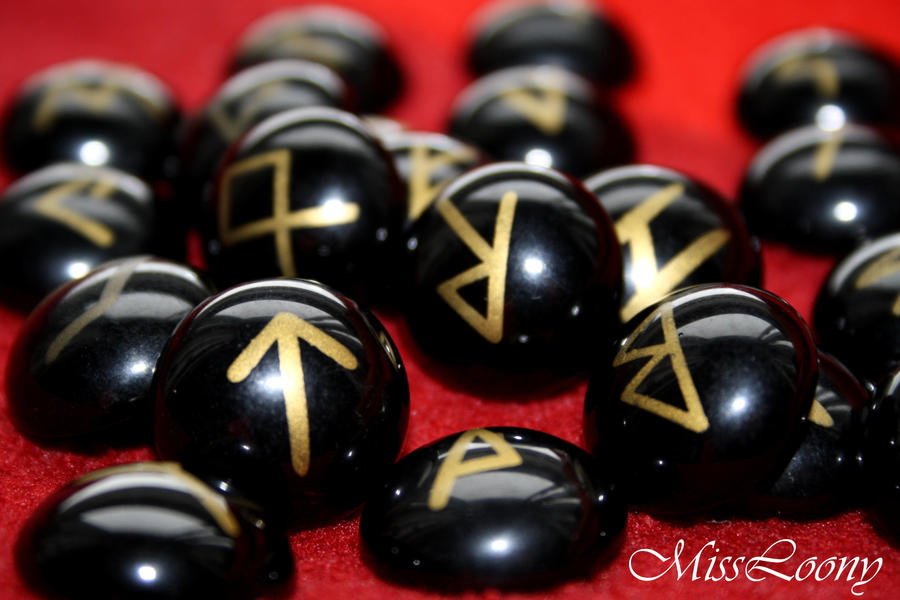 The History of the Runes
Even before the runes had achieved the status of a fully-fledged alphabet, the peoples of ancient Europe had carved their symbols into stones and trees to mark their territories and to represent their religious convictions. Symbols of this type are known as "Ur-runes" and are the ancestors of the runic forms we know today.
It is likely that the alphabetic order of the runes derives from the written leanguage of the Etruscans, inhabitants of northern Italy. The Germanic tribes in the Alps ( modern - day Switzerland and Austria ) combined the Etruscan forms of writing with their own traditional symbols and spread this knowledge amongst their kindred tribes.
From the very beginning, runes were thought to be magical in nature. They were used for the casting of lots to foretell the future and for magic influence harvests and sea voyages, to curse, to bless and to make love spells. They were also carved into sword bladed to make them more deadly, into shields so that they would provide added protection and into rings and necklaces to increase the beauty of their wearers.
True mastery of the runes was a highly respected skill of wise men and women of those times.
Those who had endured the ordeals of initiations into the mysteries of the runes were called rune masters and were consideres separate form, and supirior to, the general mass of the populace. In the Norse "safa of Erik the Red", there is a description of a woman who was wise in the ways of the runes.
The ancient Roman historian Tacitus, writting at the end of the 1st centuary AD, provided a description of the Teutonic peoples in his book Germania. Although Tacitus was mainly concerned with the customs, physique and warlike nature of the tribes to the north of the Alps, he also provided the first-known account of runic divinations.
It does not take much of an imagination to identify "the certain marks" as runic symbols cut into the wood of the "fruit-bearing tree".
Tacitus also descibes divinations taken from the flights of birds, the neighing of horses and the course of battle between two combatants.
Be that as it may, the practice of casting the runes is virtually identical to one of the methods employed today.
"She wore a cloack set with stones along the hem. Around her neck and clovering her head she wore a hood lined with white cat-skins. In one hand she carried a staff with a knob on the end and from her belt, holding together her long dress, hung a charm pouch."
"The Saga of Erik the Red"
After Christianity was introduced to Scandinavia and Iceland during the early medieval period, use of the runes for divination or in talismans war frowned upon as being akin to witchcraft. There are accounts for example, of a man being burned at the stake simply for possessing a dice cup engraved with the rune Pertho, which was belived to aid gamblers. Nevertheless, the runic arts continued secretly in Iceland until the death of the last of the great rune masters in the middle of the 17th century, which ended an unbroken mystical tradition that was then over two thousand years old.
However, this was not the end of the story for the runes. The 19th centuary saw a revival of interest, not only in the runes, but in the Nordic past in general. The mystical traditions of the Germanic peoples were again a focus for those who wished to renew their link with an almost mythical past. However, this also had a dark side in the form of extreme nationalism and overt racism, especoally in the works of Guido von List, who invented a "restored" version of the ancient Nordic alphabet that he called the "Armanen runes". Von List provided these runes complete with suitably twisted interpretations, the better to fit in with his own facist ideology. It was the Armanen runes that were used by the Nazis in Germany as source for their Swastika symbol, along with SS insignia, and to further their sinister form of neo-pagan nationalism. It is this connections of the runes with Nazi symbolism that brought the runes into a disrepute during the post-war period.
It was only at the end of the 20th century that the original purpose of the runes, now shorn of the dubious symbolism that had been thrust upon them, was restored. Today, the twenty-four runes of the Elder Futhark can be a helpful guide to the mysterious web Wyrd that governs the fate of all of us.
"No people practise augury and divination by lot more diligently. The use of the lots is simple. A little bough is lopped off a fruit-bearing tree, and cut into small pieces:
These are distinguished by certain marks, and thrown carelessly at random over a white garment.
In public the priest of the particular state, in private the father of the family, invokes the gods, and with his eyes towards heaven, takes up each piece three times, and finds in them a meaning according to the mark preciously impressed upon them. If they prove unfavourable, there is no further consulation that day about the matter."
However, this was not the end of the story for the runes. The 19th centuary saw a revival of interest, not only in the runes, but in the Nordic past in general. The mystical traditions of the Germanic peoples were again a focus for those who wished to renew their link with an almost mythical past. However, this also had a dark side in the form of extreme nationalism and overt racism, especoally in the works of Guido von List, who invented a "restored" version of the ancient Nordic alphabet that he called the "Armanen runes". Von List provided these runes complete with suitably twisted interpretations, the better to fit in with his own facist ideology. It was the Armanen runes that were used by the Nazis in Germany as source for their Swastika symbol, along with SS insignia, and to further their sinister form of neo-pagan nationalism. It is this connections of the runes with Nazi symbolism that brought the runes into a disrepute during the post-war period.
It was only at the end of the 20th century that the original purpose of the runes, now shorn of the dubious symbolism that had been thrust upon them, was restored. Today, the twenty-four runes of the Elder Futhark can be a helpful guide to the mysterious web Wyrd that governs the fate of all of us.
"No people practise augury and divination by lot more diligently. The use of the lots is simple. A little bough is lopped off a fruit-bearing tree, and cut into small pieces:
These are distinguished by certain marks, and thrown carelessly at random over a white garment.
In public the priest of the particular state, in private the father of the family, invokes the gods, and with his eyes towards heaven, takes up each piece three times, and finds in them a meaning according to the mark preciously impressed upon them. If they prove unfavourable, there is no further consulation that day about the matter."
| Keywords: Ancestors, Erik the Red, Etruscans, European History, Nazi, Runes, Tacitus, Ur-runes, wyrd

Mythology around Runes: Pertho
Mythology of Pertho:
Games of chance and skill are jointly governed by all three of the goddesses of fate, the Norns. This goes for life, too, the greatest game of chance and skill of all. In Norse mythology, these eternally weaving, enigmatic goddesses are not forthcoming with their knowledge and have to be wooed to reveal the future. Even Odin himself had to resort to outrageous bribery to find out what the web of Wyrd had in store. Although Odin had little influence with the weavers of the web, the same cannot be said for his wife, Frigga. This paragon of domestic virtue seems to have been on very good terms with them, and was additionally regarded as the patroness of women in labour. Frigga was also belived to be the mother of at least some of the Valkyries, the warrior women who rode flying steeds over battlefields to select those who had died bravely to enjoy a happy afterlife in the hall of their father, Odin.
Wyrd - The Role of Fate

Note: The photo was taken by my parents. Beautiful isn't it?
The word wyrd means fate or personal destiny. The cognate term in Old Norse is urðr, with a similar meaning, but also personalized as one of the Norns, Urðr (anglicized as Urd) and appearing in the name of the holy well Urðarbrunnr in Norse mythology ( Well of Urd ). The concept corresponding to "fate, doom, fortunes" in Old Norse is Ørlǫg.
The well of Urd or Urðarbrunnr is cited as one of three wells existing beneath three roots of Yggdrasil that reach into three distant, different lands; the other two wells being Hvergelmir, located beneath a root in Niflheim, and Mímisbrunnr, located beneath a root near the home of the frost Jötnar.
Always a bit of mythology and culture, doesn't harm anyone, but now back to the subject.
As i've tould before in an other post, in the Norse pagan view, the wyrd shows us that we are a part of a great "tapestry", which connectes us to the Gods and to our ancestors, our personal fates are influenced by the ancestors that came before us, of course i am not saying that we are fated to a certain destiny our a certain path, but rather that we have some inclinations to some things, doings and wishes. For instance, the three Norne, goddesses of fate, they sew up a great tapestry or the wyrd that connects us all to the natural world and to each and everyone of us, but they never end their work, which means that we are free to shape our lifes and find for our selfs our destinys. See the wyrd as a great web also, a cosmic web, where we are all in and connected to each other, so if one thread of this web is broken, we also feel it and we take the consequences, simple as this, if we do not respect and take care of the world arround us, this world were we are living in, sooner or later we will fall because many threads in the web are being broken.
The word wyrd means fate or personal destiny. The cognate term in Old Norse is urðr, with a similar meaning, but also personalized as one of the Norns, Urðr (anglicized as Urd) and appearing in the name of the holy well Urðarbrunnr in Norse mythology ( Well of Urd ). The concept corresponding to "fate, doom, fortunes" in Old Norse is Ørlǫg.
The well of Urd or Urðarbrunnr is cited as one of three wells existing beneath three roots of Yggdrasil that reach into three distant, different lands; the other two wells being Hvergelmir, located beneath a root in Niflheim, and Mímisbrunnr, located beneath a root near the home of the frost Jötnar.
Always a bit of mythology and culture, doesn't harm anyone, but now back to the subject.
As i've tould before in an other post, in the Norse pagan view, the wyrd shows us that we are a part of a great "tapestry", which connectes us to the Gods and to our ancestors, our personal fates are influenced by the ancestors that came before us, of course i am not saying that we are fated to a certain destiny our a certain path, but rather that we have some inclinations to some things, doings and wishes. For instance, the three Norne, goddesses of fate, they sew up a great tapestry or the wyrd that connects us all to the natural world and to each and everyone of us, but they never end their work, which means that we are free to shape our lifes and find for our selfs our destinys. See the wyrd as a great web also, a cosmic web, where we are all in and connected to each other, so if one thread of this web is broken, we also feel it and we take the consequences, simple as this, if we do not respect and take care of the world arround us, this world were we are living in, sooner or later we will fall because many threads in the web are being broken.
| Keywords: Ancient Lore, fate, Gods and Mythology, nature, Norse, Northern Pagan Traditions, well of urd, wyrd
The importance of Ancestry
 Hello to all, so this is my first Blog and my first Post , and what a great way to start, by talking about the ancestors and the importance they have in our lifes. The Ancestors are the folk who lived long before us, where our roots lie, where we come from and where are we going, we must honor our ancestors because, so will us become ancestors of our decendants in time, we are linked to all our living kin, to our families. In the Norse pagan view, we are a part of a great "tapestry", which connectes us to the Gods and to our ancestors, our personal fates are influenced by the ancestors that came before us, of course i am not saying that we are fated to a certain destiny our a certain path, but rather that we have some inclinations to some things, doings and wishes. For instance, the three Norne, goddesses of fate, they sew up a great tapestry or the wyrd that connects us all to the natural world and to each and everyone of us, but they never end their work, which means that we are free to shape our lifes and find for our selfs our destinys.
There are specific days of the year to honor our ancestors, but of course we can do so everyday, by remembering them, giving the purest of love from our hearts, choosing the right paths and the right ways to do things. The answer is always there in our hearts and mind, meditate over choices you must take, it's a good start. Be wise, never do the first thing that comes into your mind, be rational, ponder things, the wise leader always knows which battle not to fight.
Back to the subject, we honor our ancestors for exemple, at the Day of the Einherjar, or in the celtic beliefs, the celebration of Samhain.
Here it is a good story to show the importance of the ancestors, about a king that today we still remember in celebration to our ancestors and the heros who have long gone.
King Radbod (680-719 CE ) King of the Frisians:
Christian missionaries came close to baptizing Radbod, but before carrying through with the ceremony and conversion he asked a question, "Where are my dead ancestors at present?" Wolfram the Christian missionary answered, "In Hell, with all other unbelievers." Upon hearing this, Radbod changed his mind about converting and replied, "Then I would rather live there with my honourable ancestors than go to heaven with a parcel of beggars ." Beggars here refers to the long-time enemies of the Frisians: the Franks who were by this point in time primarily Christian. Radbod expelled the missionaries from the kingdom for no other reason than how important his ancestors were to him.
Note: The Art work was made by me, a gift to my Grandfather at his 80th birthday. You can watch all of my works by clicking the Portfolio bellow to my Deviantart where other works of mine are.
| Keywords: Ancestors, Ancestry, Arith Härger, King Radbod, Nordic, Norse, Norse Gods, Northern Pagan Traditions, shamanism, Vikingwidunder, wyrd
Subscribe To


 Posts
All Comments
Posts
All Comments