Wight of the Nine Worlds

welcome

I welcome thee free spirit, which thou shalt come with an open heart, open mind and an open soul, for what you are about to read can only be understood by the wise who are eager to learn and to embrace the roots deep and forgotten in the hearts of the free people of Europe, by accepting who you are and where your roots lie, is half way into the great road of life. We will journey unto where our spirit takes us with the knowledge we gained. Learn and teach.

Dalecarlian runes


We usually associate runes with the Vikings, although these symbols have been an early form of writing spread all over Europe since the late Bronze Age (possibly even before that). Our ancestors started to produce geometrical symbols; they perfected them, simplify them, until we start to see in archaeological context the early forms of what would be the runes. This form of writing soon came to an end when Romans started to conquer Europe and the latin alphabet replaced the old forms of written language. But far in the north the runes remained till late, due to the fact that romans had little influence, if any, in those regions. However, christianity eventually reached Scandinavia during the middle ages, and it was thought that the Vikings might have been the last people to use the runes in a daily basis, and that the runes continue to be used only for magical purposes. But in the hidden deapths of Scandinavia, people still used the runes as far as 100 years ago.

The runic alphabet was the dominant written language in Northern Europe until the advent of Christianity in the 9th and 10th centuries introduced the Latin alphabet. By the 15th century the Latin alphabet had almost wiped out the use of runes. But here, in Älvdalen, the runes remained very much in use.

In Älvdalen, near Dalarna, in western Sweden, the local population continued to use the runes for centuries after the ancient written language had been abandoned by the rest of Scandinavia. Until the early 20th century the runes were still used there. The inhabitants of this region retained their very special language - Elfdalian - which is an other completely different language apart modern swedish (an unique old Norse tongue).

Here is an example of the runes used till modern days:

Illustration from: [Arakun/Wikimedia Commons]


As you can see, the runes of Älvdalen - dalrunerne - are reminiscent of those used on runes stones in countries such as Denmark, Norway, Sweden, etc., but there are a number of differences. Dalrunerne developed over time, influenced partially by the Latin alphabet. The use of runes in Scandinavia gradually ceased during the 15th century. Although there were some areas of Gotland, in Sweden, and in Iceland, where the rune tradition survived until the 17th century, but in Älvdalen     their use was widespread until the early 20th century.


The runes in Älvdalen were most commonly found on houses and inscribed in furniture, and were also engraved into "message blades" which were sticks of wood that were circulated among the farms in the area. It's really interesting to see that the people who herded the cattle up in the mountains would write messages to each other in runes.

This wonderful linguistic and traditional treasure remained till late due to the isolation of this region. A place deep in the Swedish forests and mountain ranges, hard to get into. While the rest of Scandinavia, and Europe, the Latin alphabet and Germanic dialects spread and gave way to the modern languages of the European linguistic-branch, in Älvdalen a little bit of the past remained frozen in time.

Ritual Spear found in Poland


A ritual spear dating back 9,000 years - made of wood and decorated with engraved ornament - has been discovered by archaeologists in Bolków near lake Świdwie (West Pomerania). The spear is an unusual artefact. The unique aspect of the find is the rich decoration on its outer, slightly convex side: interwoven geometric and zoomorphic patterns. The construction of the spear, and above all the presence of ornamentation indicates that it was a ritual object associated with the beliefs of the Mesolithic peoples inhabiting the lakeside settlements and hunting camps.

Communities living in the Mesolithic period often adorned items they used. In Europe there are known carvings made on various objects made of antlers and animal bones, wood, and rarely also on objects made of amber, flint and on stone pebbles. They represent the wealth of stylised depictions of forest animals, birds, fish and plants, as well as human figures.

The carvings on the spear showed the presence of different combinations of geometrical patterns in the form of single and grouped triangles, zigzags, herringbone, horizontal and vertical short notches and the dominant theme of short perpendicular incisions, arranged along the lines. Also visible are depictions of stylised human and animal figures. The analysis shows that central place in the image formed by the carvings has a ritual scene with three human figures. One of them is wearing a characteristic mask, made of widely branched antlers. "It certainly symbolizes a shaman - a spiritual guide of the community. The second figure is shown without clothes - drawn with a single thick line. Its position suggests performing a ritual dance. Hands are raised upwards. The third figure is presented in a long robe and carrying a bundle, possibly an offering. The scene takes place on the shores of a lake, by two boats. On the opposite side, in the background, there is an encampment composed of at least four shelters, presented in the form of several adjoining slender triangles.

The spear was discovered during excavations in the vicinity of previously studied shamanic sanctuary from the early Mesolithic. According to archaeologists about 9,000 years ago mysterious rituals were performed in this place. Archaeologists have been studying traces of these enigmatic activities since 2012. During that time they discovered, among other things, a meteorite located inside one of the huts, a wooden censer used during rituals, an unusually shaped stick, and even an object is made of birch bark, which is described as a fragment of a ritual mask.

Viking Cats - Onward to conquer!


We know that cats have already conquered the internet with their cuteness and silly behaviour, but in the past they have also conquered lands! Well . . . not likely, but the latest and largest genetic study of cats revealed how our fluffy friends spread across Europe, Asia, and Africa, and even sailed aboard Viking ships.

The world’s first large study into ancient cat DNA reveals that the earliest ancestors of these furry fellows reached Eurasia and Africa at the same time as early farmers (during the Neolithic), and were later helped by sailors, including the Vikings. It was already known that cats reached the shores of Europe through the mediterranian sea during the Bronze Age, but now this study shows that cats have landed in European soils in a much distant past.

Scientists sequenced the DNA from 290 cats from more than 30 archaeological excavations throughout Europe, the Middle East and Africa, including the remains of a cat in a Viking grave in northern Germany.

But why were the Vikings so important in spreading these feline conquerors? Well, cats have their importance in Norse mythology, and were often connected to specific deities. Of course I will mention the goddess Freyja, notoriously known as the goddess of love. In the Norse Mythology she has two cats that pull her carriage. And, of course, there is that one tale when Thor visited Utgard and he tried to lift the gigantic Utgard-Loki’s cat. It turned out to be a serpent, the Midgard Serpent, which not even Thor could lift; a spell was at work in this tale. Suffice to say, in this tale as well as Freyja's cats, there is a connection between cats and magic, because Freyja herself is also one of the few Norse goddesses to be closely connected to magic and Seiðr work - a type of sorcery which was practiced in Norse society, closely related to shamanic practices which I will not delve much into the subject because we are talking about cats dear friends.

There are other tales about cats in the Norse mythology, so it's safe to say Vikings cared about their cats because even the gods had them. When cultures include a certain animal in their mythologies, or in their cultural and traditional code which defines them as a people, it shows us that these animals where very important to these societies, which is why they gained a connection with the gods in the first place.

Anyhow, in this new study, samples were taken from the remains of cats dating to as recently as the 18th century and as far back as the early Stone Age. Around 8,900 to 3,900 years ago, when Europeans had not yet adopted farming and still led a hunter-gatherer lifestyle.

It seems that cats spread throughout the old world in two waves. The first wave arrived with the earliest farmers in the eastern Mediterranean, as indicated by the discovery of 9,500 years old graves in Cyprus. It contained the remains of a cat and suggests that the relationship between humans and cats dates all the way back to the early days of the Neolithic period. The second wave took place thousands of years later as cats from Egypt quickly spread to the rest of Africa and Asia. Their genetic markers were discovered in cats from Bulgaria, Turkey, and sub-Saharan Africa that also date to around the same time.

It is possible that the friendship between people and cats arose as early farmers began to store grain. The grain attracted rodents, which in turn attracted wild cats, and so began the mutually beneficial relationship with our feline friends. Yes, cats to care of rats and so the grain was safe. This is exactly like the relationship of humans with early dogs. The domestication of wolves and wild canine creatures created the best friend humans could ever have - a guardian to ward of dangerous animals and other predators. In a subtle way, cats also made their way towards humans, showing their abilities and their usefulness, thus becoming equally important. Cats also helped to keep down the numbers of rats and mice on ships, during long voyages at sea, so it's perfectly understand why cats were brought by sailors.

A Viking grave, discovered in northern Germany, is believed to date back to somewhere between the 8th to 11th century CE, and there was a cat in it which helped in the study. A search in the Natural History Museum of Denmark database of archaeological finds showned that there is no doubt that cats were commonplace inthe Iron Age and Viking Age of Denmark and that people commonly wore cat skins by the late Viking Age.

With certainty,  there were domestic cats back then, in the Viking society, because of their size which is related to the type of life of a household cat. Wild cats are larger and their bone-structure is much different, whilst dosmetic cats are smaller and are nowehre near the size of their wild cousins.

According to archaeological research there are also evidences that cats made it to Greenland, which points to the first Europeans to step into those lands - Vikings. Vikings carried cats in their longships probably for the same reason as everybody else, but maybe also because their connection to the goddess Freyja. Mayhaps it was easiler to bring domesticated creatures to a new land, rather than other animals more wild in nature and also connected to magic.

New Shaman Sanctuary Discovered in Europe


Archaeological findings related to shamanism aren't very common to find in European ground. It's easier to come by such findings in the most inhospitable regions where shamanic practices lasted several thousands of years till or modern era, and in some places these spiritual traditional practices are still alive. When it comes to Europe, with major historical changes not only in society but also in the landscape, history itself and religion, the shamanic practices were long forgotten and the place where once shamans worked, were brought down and completly destroyed.

However, archaeologists uncovered an unusual site near Lake Świdwie, in north-western Poland, and this might be one of the major European findings related to the shamanic pratices of the old European peoples. After analyzing the settlement, the team of researchers concluded that it dated back to 9,000 years ago.

One of the most notable findings in this area consisted in a circular design of approximatly 6 meters in diameter where the foundation of strange structures was still visible. A trapezoid building with poles, encircled by an arch of rocks aligned at equal distances from each other. Within this ancient design, sharpen yew sticks were piercing through the ground so that they formed the shape of the Big Dipper – a fragment of the constellation Ursa Major, also known as The Great Bear.

Other enigmatic pieces of wood used in smoking rituals, bark, herbaceous plants and animal bones presumably used as offerings and for driving off evil spirits before a ritual were also unearthed at the site.

A rich collection of different stones with, supposadly, supra-natural properties were also found inside the sanctuary. Among them were syenite, diorite, granite, quartzite, sandstone, gneiss, and even unusual rocks for the Pomerania area such as red marble and green syenite. However, the discovery of black amber and pumice – an extrusive volcanic rock obtained when molten lava is spit out of a volcano – topped off the charts of the discovery list.

The site furtherly proved to be rich in items mostly made of wood such as pendants and wood masks used in the mystic rituals. Thanks to the favorable conditions of the area, all the unearthed pieces were preserved in perfect shape.

As I've said before, this discovery is unique, as other shamanic settlements closer to Europe were only found in Siberia and Mongolia. Apparently this settlement served as a sanctuary from where the spirit-workers engaged into rituals and out-of-body experiences, through trance, frenetic dancing, induced substances and so on.

This discovery adds another dimension to our written history because it proves that shamans once ruled the plains of Europe before Christianity and other religions rushed in and wiped these timeworn culture. It also demonstrates that ancient Europeans had knowledgeable advisors who could read the stars, use advanced remedies from nature, and who knows what other ancient techniques that are now forever lost.

Archaeological Find in Iceland - The First Settlers?


Archaeological excavations in Stöðvarfjörður, the East Fjords, reveled interesting signs of human presence dated 74 years before the official settlement in the area by the first humans who came exploring the country. It seems the country was inhabited as early as the year 800 which means the first Viking explorers were not the ones who came to settle in 874 but there were people before who made the preparations for an official colonization of the area.

However, this is not the first time that signs of human presence from a similar time have been discovered. Excavations in Kvosin, Reykjavík, Hafnir, Reyjanes and in Húshólmi, had already given the hint of older settlements in the country. But now this one in Stöðvarfjörður came to cientifically prove the previous thought that Vikings settlers had been here way before the official historical record.

The Stöðvarfjörður is a strategic location, because the fjord has a good harbor and is the country’s closest location to sail to and fro Norway and the British Isles.

The first structure to be detected was a longhouse-shaped building with thick floor layers. The long-fire structure which was usually at the very center of the house is missing, but a fireplace can be seen by the wall. This structure is typically Nordic. The items are of the same kind as the ones which had been found in the whole Nordic area (including the Scandinavian Peninsula and all the way to the British Isles). This first settlement probably wasn't the type of farm-settlement, but an outpost that served as a predecessor to a real settlement.

The lack of animal bones in the area suggests that these settlers did not keep animals here, but used this place as a seasonal residence in order to exploit the natural resources the area offered.

Several tiny items of great importance to this finding, and a link to the first settlers, have been found. For instance, a sharpener, pearls, washers, a ring and a silver coin. A chalcedony discovered at the site proves that these first norsemen made utensils out of stone. This might give us a clue from where these people came from. In Northern Norway, during the medieval ages, it was still common for people to make tools out of stone. It became a sort of a costum to make stone tools in that area, while in other places these techniques had been put aside for a long time and in most cases had been forgotten. These first settlers were skilled in making stone tools, which suggests they were used to do it and this might indicate that they probably came from the northern regions of Norway.

New Pagan temple in Poland


You can see my video, talking about this subject, at: [New Pagan Temple in Poland & Religious Freedom]

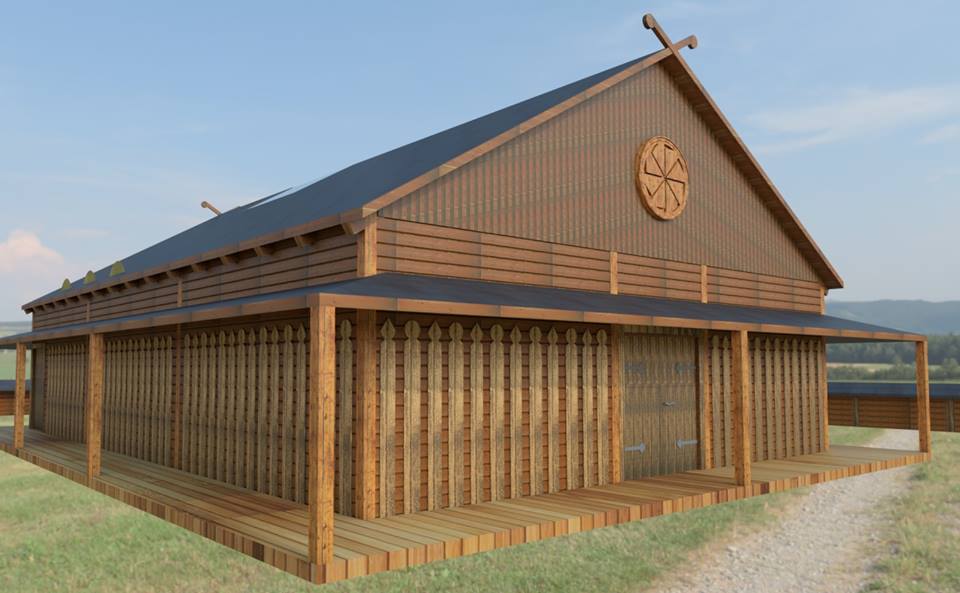
It's happening again; first it was Iceland who started to build the first major nordic pagan temple after a thousand years of christianization in the land. Then, it was Denmark with a very beautiful viking wooden themple to the norse gods. Now pagan history continues with a project to make the first pagan temple to the Slavic gods in Poland, after christianization spread through the land and wiped out all the old temples to replace for the ones of the new faith.

This year, Poland celebrates the 1050th anniversary of Christianization of the country and its people. But the pre-Christian believes were never truly forgotten or left aside, and the pagan faith still lives on. In the city of Wrocław, in Poland, the neo-pagans, or the rodnovers from the Slavic pagan association Watra, have a new project in had - to build a temple to their old slavic deities. For now, only a digital visualization of this temple is available, which is based on the architecture of the old Slavic temples, acording to historical sources.

The importance of this temple is not focused in the old faith, but rather in concentrating the Slavic culture and traditions in this place to rise awareness and to educate people about the history of their ancestors.

There seems to be an uprising (in a good sense) of pagan culture throughout Europe. After a thousand years of oppression from a foreign faith, the peoples of Europe are turning to the old ways of their ancestors. This is very important in a way that we musn't forget who we were, our traditions, our historical past and our cultures. For the future generations the history we are making today will help them to understand the essence of their ancestors. Most of the knowledge of the past was either lost or still remains a mystery, and now with the help of historians, archaeologists and antropologists, we are able to dig the past (literaly speaking when it comes to archaeology). I understand that for those who have other faiths which have the tendacy to dislike the pagan old ways, this uprising might frighten them, but we live in a world were religious freedom should be as natural and normal as waking up and breathe. No one has the right to bind people to a certain faith/spiritual path. A world where religious freedom is possible, is indeed a better world and half of humanity's troubles can be averted.

Here you have the 3D visualization of the pagan temple in Wrocław which is about to be built:


If you seek more information about this subject, please visit this link and support this project at: https://zrzutka.pl/en/rodzimowierczaziemia

Freydís Eiríksdóttir


Because history isn't always made by men and great women have also helped shaping the course of events so we might live their legacy.

In this post I will write about Freydís Eiríksdóttir. Yes, you are correct, the daughter of  the famous viking, Erik the Red. But let us put Mr. Red behind us; we have all listen about his tales. In fact, we are well aware of the Viking heroes, Chieftains, Jarls and Kings which have placed their markings on the world and forged their own fates. But seldom do we hear about women and how important their roles in society have been, are, and always will be.

In the Sagas of the Greenlanders (Grœnlendinga Saga), Freydís Eiríksdóttir is described as being Leif Eriksson's own sister. However, in the very Saga of their Father (Eiríks Rauða Saga) she is Leif's half sister. One thing is clear, she had strong family bonds with these historical characters. It isn't known when she was born, or where, but we can be certain it was arround the late X century.

She once lived at Gardar (Garðar - Greenland). This fearless woman joined two trips to Vinland (North America) during her early years, probably at the beginning of the XI century. During one of these voyages, and after a failed attempt to trade with the North American natives - which the Norse called Skraelings (Skrælingjar) - a dispute arose between the two groups.

Not every viking is bold, brave and fearless. This particular conflict had the vikings on the run. During the night the North American Natives ambushed the viking camp. Throwing arrows, spears and other such weapons, the Skraelings frightned the viking explorers. This upheaval drew Freydís' attention and she ran towards the conflict. While others were fleeing, she was going on the opposite direction to face the Skraelings. It is said she was weaponless, and so she took a sword from a fallen brother-in-arms; in some accounts it is written that she was eight mounths pregnant and even so she fought. When the Skrælingjar came upon her, or vs versa, she let down her sark so that one of her breasts was exposed and struck it with the flat of her sword, letting out a furious battle cry. Perhaps the attackers did not expect any resistance, since their plan had work so well and the invaders were on the run, but when they saw this woman, shouting and with sword in hand, the Skrælingjar were rightly frightened and stormed off back to their lands.

There was a second trip to Vinland. Freydís wanted the prestige and wealth that was associated with a Vinland journey, so she planned in returning and make profit with it. It wasn't easy to make these journeys, you have to understand it was a new sea route to an unknown land, and there was clearly resistance from the natives which turned things even more dangerous. So Freydís had to make it count this time. 

Helgi and Finnbogi, norse explorers going to Vinland, had arrived to Greenland. Freydís made a deal with the two men, porposing that they should go together to Vinland and share all the profits half-and-half. She then asked her brother Leif if they could use the homes he had built in Vinland so they might take shelter and have a base of operations. He agreed to that. Helgi and Finnbogi also agreed that they would bring a good number of men and supplies, but the two men went alone without her. She ended up leaving afterwards, with her own ship and her own crew. The two men arrived at Vinland first, and took refuge in Leif's houses. Freydís appeared and ordered the brothers to move out. The houses belonged to her brother and she had the right to use them as befitted her. The two men left and camped elsewhere.

In Vinland the tension between the two groups grew as Helgi and Finnbogi set up a settlement separate from Freydis and her crew. She went to where they were camped to make peace. They made peace eventually and to the two men all seemed right. Until Freydis went away and beat herself so that it would appear as if she had been mistreated and beaten. She returned to her husband in her brother's houses, and as a good husband he asked who had beaten her. Freydis claimed Helgi and Finnbogi had done the deed while calling her husband a coward, demanding that he had the right of revenge on her behalf, or else she would divorce him. He gathered his men and killed Helgi and Finnbogi as well as the men in their camp while they were sleeping (well, killing a sleeping enemy is indeed an act of cowardice). When he refused to kill the five women, Freydis picked up an ax and massacred the five women herself. She was bloodthirsty and clearly begrudged. The two men went without her to Vinland and she was upset about it. She took her time, patience and schemed about the best way to have her vengeance. Such a petty thing to want vengeance for. I dare not imagine how she would act if a deed against her had serious consequences.

Freydís wanted to conceal her treachery on the brothers and threatened death to anyone who would tell of the killings. She went back to Greenland after a year’s stay and told her brother Leif Eiriksson that Helgi and Finnbogi had decided to stay in Vinland. However, word of the killings eventually reached the ears of Leif. He had three men from Freydís’s expedition tortured until they confessed the whole occurrence. Thinking ill of her deeds, Leif still did not want to imprison her, or convict her to death for manslaughter. After all, she was his sister.

Unfortunately, nothing else is known about Freydís. It is clear that she put the men around her on their heels. She cast fear upon friends and foes alike, and I believe she could easily make enemies rather than friends, and people would follow her out of fear and not loyalty. Both terrible and an incredible woman; full of mischief, bravery, leadership and a mixture of lunacy, which are the perfect ingredients to survive the world of ruthless cold-blooded men of her time. To thrive among such people, she had to be equal to them or even worse. Enough to cause both respect and fear.