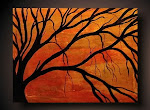
Note: The drawing was made by me, you can see all of my works by clicking on the Portfolio bellow.
This Tale can not be found in any lore, those who wrote the ancient storys of the Gods and their doings, did not work with the Jotnar. This specific story was told to a friend of mine who works with the Jotnar and he told me the story, so i do not have any credit over this, excepct on the art work. The tale was told to me by Raven Kaldera, here it is a link to his website [Link] Enjoy.
The Birth of Loki - Laufey's Son
In the beginning, there were the frost giants of Niflheim and the fire giants of Muspellheim, and when the great flood came, many were washed away. Some found safety on a piece of Ymir's body that congealed into a new world, and they named it Jotunheim - the new home of the giants. Some say that it was formed of Ymir's spine and shoulders, for it formed itself into a land of great and imposing mountains, trees that nearly reached the sky, huge and fierce animals that roamed the dark forests, and lightning storms that split the sky.
The surviving Jotnar found it welcoming, and they married each other and produced many new Jotnar - the mountain-etins, the woods-etins, the sea-etins. Some settled high in the cold northern mountains, or the western mountains by the ocean, or the islands, or the eastern rain forests, or the southern woodlands. And in one place in the south of Jotunheim, they settled in a strange forest. Its trees were shorter and harder than anywhere else in the world, and they bore strange fruit. Magic leaked from the very earth; the place reeked of it, and tainted everything that was born there. The etin-folk named it the Iron Wood, and the recognized it as the sacred heart of Jotunheim, the wellspring of its magic. Werewolves and werecreatures were born there, and beings strange and twisted, but their deformities were considered a sacred thing. For a twisted troll to say that he had the blood of the Iron Wood was to replace scorn with reverence in the eyes of the onlookers. Magic ran strong in the blood of the Iron Wood folk; seers and galdr-folk came forth from that place, to marry and spread their bloodlines through all the etin-folk.
The folk of the Iron Wood divided themselves into nine clans, and each elected a chieftain. There was much fighting as to who would be Chief of Chiefs, however, and many were slain in the battles, and the blood soaked into the earth. Finally the fighting came down to two clan chiefs, both of whom swore that they would defeat the other and win the leadership of the Nine Clans.
One was Farbauti, whose name means Cruel-Striker, and whose clan was Lightning. He was tall and strong and broad as the side of a mountain, and belched fire from his mouth. Fire-giant blood ran strong in his veins. The other was the young chieftess of the Wolf clan, a powerful witch with the lineage of the Volva in her. She was tall and strong and had hair the color of dried blood, and she could see into the future and prophesy. And she saw that she would be Chief of Chiefs, and set out to make that prophesy come true.
And it came to pass that Farbauti went from the Iron Wood and came to the western mountains, and thence to the ocean, and he wandered in a boat among the many islands off the coast of Jotunheim, some so close to the world's border that one could almost see Vanaheim in the distance. And it was there that he met a beautiful giantess named Laufey, the Lady of the Leafy Isle. She had earth-goddess blood in her, old and ancient as Jord, and she shone like silver in the moonlight, and Farbauti could think of nothing but her from the moment that he saw her.
It is said in the lore that he struck her with a lightning-bolt, and thus was their son born. The truth of the matter is that love and desire for him did indeed strike her like lightning, and the fruit of that love and desire was that she swelled with child. Yet she had not gone but three months before her womb began to burn, as if a brand flamed there, and it caused her great pain. Farbauti feared for her, and wished her to return with him, for there were healers in the Iron Wood who understood the nature of its bloodlines. She agreed to travel with him back to the Iron Wood, although she sorely missed her leafy isle, but she understood that their son must claim his right to the chieftainship, should it come to Farbauti's death. Her husband built for her a cottage out of stone, and guarded it, for he feared that the wolf-chieftess might strike at her.
He was right in this thinking, for the wolf-chieftess heard of Laufey and her swelling belly, and the Sight came on her, and she saw as in a hazy dream that this son of Farbauti's might someday master her. So she called upon her brothers and sisters, and in wolf's hame they set upon the cottage, where Laufey lay within moaning in pain, for her time was almost upon her.
Great was the duel between Farbauti and the wolf-chieftess, and many scars they left upon each other, but in the confusion Laufey slipped from the house and fled as fast as an etin-woman laboring could run. She fled the Iron Wood, but the wolf-giants came after her, sniffing out her trail. She fled from Jotunheim itself, and crossed the world-border into Midgard, yet still they followed her, and the howling froze the blood of the Midgard humans who heard the chase. She fled into the Myrkwood, so fast that the fierce tribes who lived there could not catch her, but the wolves followed. And so it was that she came to where the trees of the Myrkwood were charred and blackened, and saw the burning waste of Muspellheim beyond. And she knew somehow that the burning in her womb had brought her here, to the burning land.
As she stepped foot into Muspellheim, Surt the Black came forth with his men-at-arms, and challenged her. "What seek you here, island woman?" he growled.
"I seek sanctuary, in the name of the father of my child, Farbauti, who is descended from your sons," she gasped out. "For his enemy is hot on my heels, and this child pleads to be born."
"What will you give me, island woman," Surt asked, "if I shelter you from all harm until there is no more harm to come? What will you give for your protection?"
Laufey held out her hands, and showed that she had nothing on her save her shift. "I come empty-handed into your kingdom, my Lord Surt," she said, "and I have nothing to offer. What would you have of me?"
"Empty-handed, perhaps, but full-bellied," Surt said. "Give me the treasure that you carry. Let me be godfather and second father to your child, and I will give you both sanctuary, for as long as you wish."
Laufey hesitated, for she did not wish to betray Farbauti, but the wolves were howling in the distance and her womb burned so that she could no longer stand or walk, and she finally gave in and agreed. Surt bore her to his castle, and the wolves were stymied, and howled many days along the border of Muspellheim, but they did not dare enter, for Surt was too powerful in his own kingdom, and the very land would rise up against them and burn them to death, and so Laufey and her son were saved.
Surt's palace is hewn from black glassy rock, and his hall has many fireplaces around it, big enough to cook an ox and still have room to turn the spit. And it was in the largest of these that Laufey lay down in the coals, and she lifted her skirts and spread her legs, and a burning brand came forth from her body. Surt took tongs of iron and drew the brand forth from her, and as he did so it became an infant boy with hair the color of flame. And so was Laufey's son born.
Laufey sent to her husband, telling him that he had a son, and pleading to return. But Farbauti was still at war, and felt that it was too dangerous for his wife and child, and he bade her bide with Surt until it was safe. But the years passed, and it was still not safe enough in Farbauti's mind, and all Laufey's pleading had no effect on his fear. Laufey burned first with desire for her absent husband, then with resentment, then with anger. Meanwhile, Surt the Black raised her son like his own, and showed him the mysteries of fire, and the fire-blood in his veins.
When Laufey's son was thirteen years of age, and was going from child to youth, Farbauti sent to Laufey and told her that it was over, and the wolf-chieftess had won. He had agreed to a truce, for she was more powerful than he, and she had been elected the Hagia, the Wise Woman and Chief of Chiefs of the Nine Clans. In return for giving her the title, he bade her promise not to harm his wife and son. So Laufey made ready to go, but before they left a seer of Muspellheim came forth at Surt's bidding and prophesied for Laufey's son.
The seer looked deep into the red-haired youth's sharp green eyes, and she gasped, and said, "You shall have no home, wanderer, save the road itself, and that road will be hard for you, and yet all places on the road shall be your home. You shall have freedom greater than any other, yet be bound by your own choosing. You shall be dearly loved and terribly hated, and little understood. Your name shall be more well known outside the Nine Worlds than any other name in the Nine Worlds save two, and one shall be your blood brother and the other spring forth from your loins." And with this prophecy, they left for the Iron Wood and came to Farbauti at last.
Farbauti made ready to welcome Laufey back, but she spoke forth in anger, and said, "You would not let me share your danger, but only your safety, and I say that this is not love. For I would have died by your side, yet you ordered me apart. So I will not live here with you, but will go up into the mountains that look down upon your forest, and there I will build a home and live. You may visit me when you will, but I will not live with you." And Farbauti wept for the first time, but there was no moving Laufey, for her feet were planted like the earth.
So Farbauti turned to his son, and said, "Will you go with your mother, then, or will you stay here with me, your father?"
Laufey's son was silent a long while, which was surprising to those who knew his quick tongue, but finally he said, "You are the father of my blood, but you were not there when I needed you as a child. Surt the Black cared for me then, and which is more important: the father who gave me his blood, or the father who gave me his time? I cannot choose, and so I will not. I will live with you, Chief of the Lightning Tribe, until I am a man, but I will be known henceforth only as Laufey's Son." And Farbauti accepted this, although with heavy heart.
Laufey spoke forth, and asked, "Will you bring our son to the council of the Clans, and see him welcomed into the Nine?" But Farbauti would not go forth where the wolf-chieftess held court, and he would not see his son welcomed with her hands, which was not all pride, for he still feared that she would break her word and kill his son. Laufey laughed and said, "Seers have spoken for our son, and they did not see him dying before his time, so I will take courage and go before the wolf-chieftess and demand our son's heritage." And a council was called, and she brought her son before them, and Farbauti watched from the trees lest there be foul play.
When the wolf-chieftess heard, she was sore in her heart, for she remembered the dream wherein it was whispered that Farbauti's son might one day master her, and she did indeed contemplate killing him in spite of her word. And with this in mind, she hid a knife in her skirts, even though the deed seemed evil to her. Yet when Laufey and her son came to the clearing where the Council stood, and she faced the youth across the fire, with his flame-red hair and his sharp green eyes and his three-cornered smile, the vision came on her again, and she saw it more clearly this time.
And she saw that someday, not far off, when Laufey's son came to manhood, he would come to her and would indeed master her, but that mastery would be Love. He would become her consort, and he would be the father of all of her children, and she would love and desire him above all others, and sometimes hate him as well. And she saw also that he would be her greatest joy and her greatest sorrow, and that he would be the eventual cause of her death, and her rebirth. And she saw also what the seer of Muspellheim saw, that he would wander forever, and be loved and hated, and come to both fame and infamy. And she would have wept, but she was too proud; and she would have screamed at the trick that the Norns had played her, but she saw the wyrd that must be, and that it was her orlog to take part in this path. The knife fell from her stiff fingers, to bury itself unseen in the earth.
So Angrboda did the only thing that she could do. She stepped forward, in all her regalia of the Hagia of the Iron Wood, and she welcomed him into the tribe, saying, "Laufey's son, child of the lineage of Farbauti, you are welcome into the Nine Clans of the Iron Wood, the sacred heart of Jotunheim. We are your family, and we will guard you, and succor you, as long as you live among us. May none who hear me ever say otherwise!" And she threw back her head and howled, and there was sorrow in the howling, and all wondered to see it, but they all joined in as well, and with one great howl Loki was swept onto the path that would be his life.


 Posts
Posts